

Boston Focus, 11.1.24
Some things I have read through recently...

Welcome. I appreciate you following me here and thank you for your patience as I work out the kinks on a new platform. And, to repeat one last time: yes, you will get this email each Friday; no, you don’t have to pay for it, but you can choose to support this newsletter by clicking the little button below. Many thanks to the many who have chosen to already!
Leaves are just falling, and schools are already preparing for September, 2025.
Boston Public Schools is deep in planning and budget projections. The Boston charter application is already live. And as you drive around parts of Boston, many of the lawn signs you see are not asking for your vote next Tuesday.
They are asking you to enroll your child in a school.
The state released updated data on individual private school enrollment, and the Boston data doesn’t quite fit the post-pandemic think pieces about public school flight or personal anecdotes.
Enrollment in Boston’s private schools initially declined during the pandemic, only to increase in the last year.
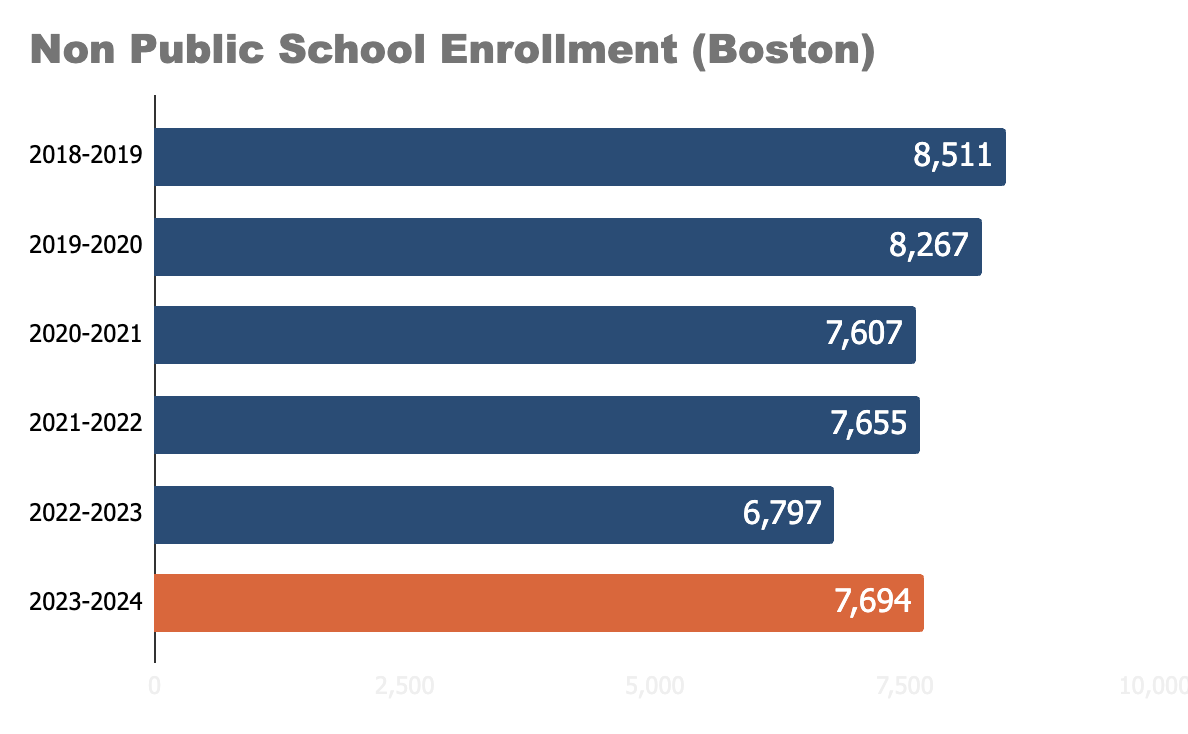
The actual share of private school enrollment has now surpassed pre-pandemic levels.
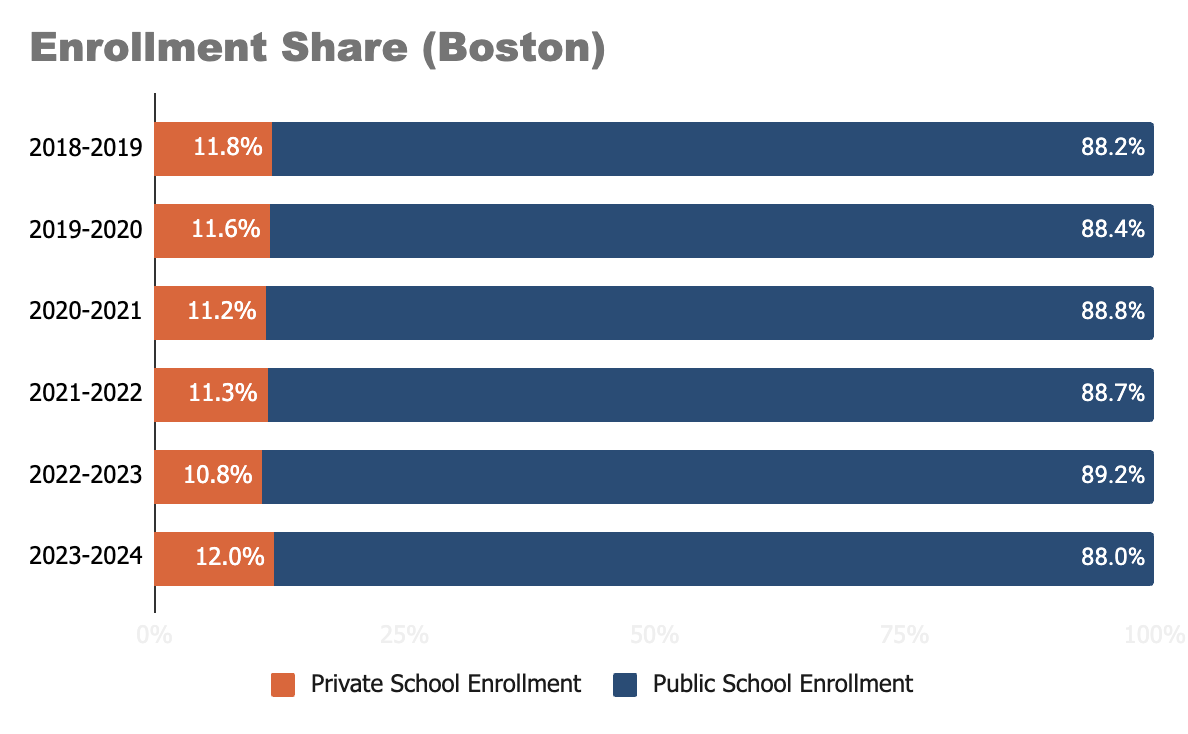
What is going on here? It’s hard to tell.
As I have written before, the state data doesn’t tell the whole story because it does not capture private school enrollment based on a student’s geography (e.g., a Boston child attending a private school in Milton). If you scroll through the state’s individual school reports, you find years of missing data (like this). Further, swaths of preK enrollment could be missing, particularly in Boston, where preK enrollment is subsidized by the city not only in schools, but also community organizations.
Even though ~20,600 children don’t attend Boston Public Schools, their residence in the city affects Boston Public Schools. In the context of enrollment decline and a master facilities plan that has no child population estimates or projections, this represents missing data for the district to accurately plan and meet its goals.
Rather than pulling together different state reports piecemeal at various times, it is time for the city to invest in its own comprehensive data system, not unlike the one built by the state. In addition to providing critical data, such a system opens up opportunities for resource allocation, research, best practices, and improved outcomes. Something like this has been proposed before.
We should expect clear information on all of Boston’s kids, at the very least, where they go to school.
Schools
Boston School Committee had a retreat on Tuesday. Here is the deck.
With performance still lagging in the afternoons and for sports, Boston is spending more money to bus less kids. By how much? When measured by the actual number of bus rides provided, busing costs have increased by 239% since 2014.
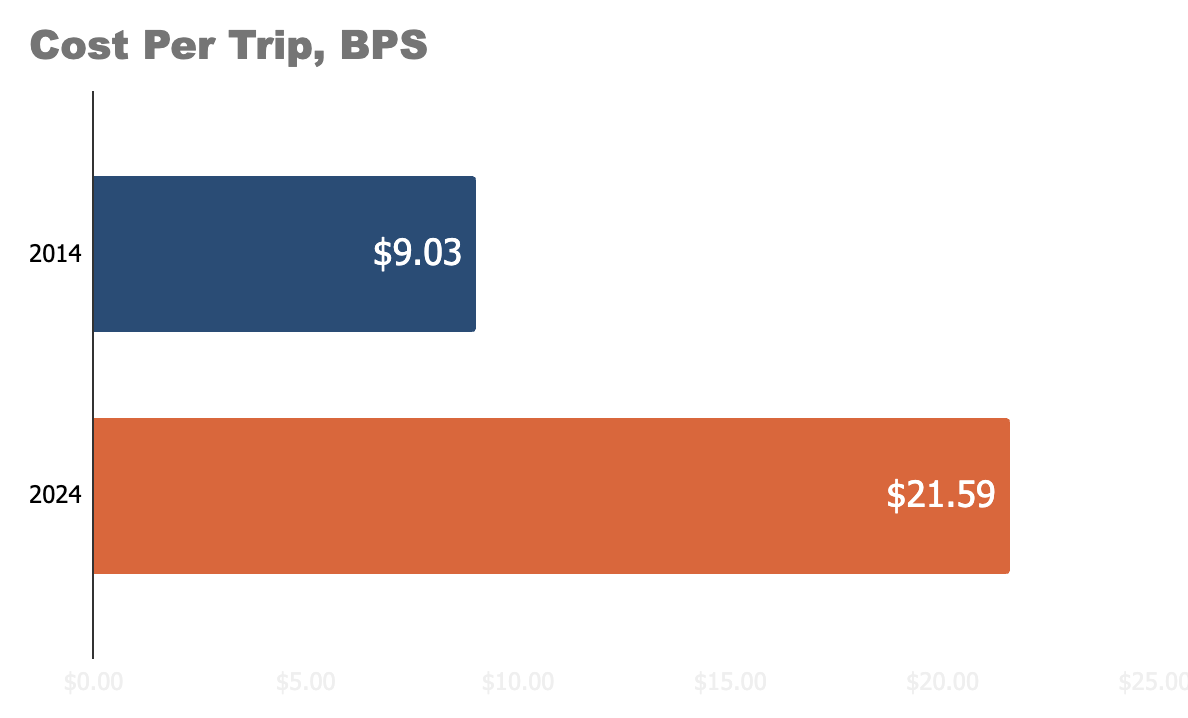
A quick Google search reports a 4-mile Uber ride in Boston is approximately $20.
Will new non-profit and school buildings revitalize Newmarket?
Last week of Question 2 coverage round-up before election day. Another primer, if you still need one. The latest polls still show “yes” in the majority, right at the margin of error. Yes on 2 questions how MCAS research is being publicly represented. This coverage of the Boston Debate League from last week highlights student contributions, but omits an important data point: a room of high school students and educators increased their “no” vote by +15% after hearing both arguments.
New to Yes on 2: Senator Markey and Cambridge Day. Mayor Wu and Boston did not take a public position. WCVB questions whether Question 2 should be on the ballot in the first place. Secretary Tutwiler continues to publicly oppose Question 2, including at Tuesday’s BESE meeting (with labor leaders disagreeing outside). Editorials opposed: the Boston Globe (again), the NYTimes, an East Boston teacher, a former superintendent, Massachusetts parent and education advocate, and state Latino leaders.
Dueling expats: Medford native Michael Bloomberg donates $2.5M to support “No on 2,” while Cambridge-born Matt Damon releases a selfie video urging “Yes on 2.” Both men have residences in New York City, which lost the World Series on Wednesday.
For all this coverage, what is the 10th grade MCAS like anyways? You can take it here. If the formula for the volume of a cylinder doesn’t come back to you right away, don’t forget you only need to get 2 or 3 of the math questions right to pass.
The big news at this week’s Board of Elementary and Secondary Education meetings (materials here) was the announcement that Holyoke is on the path to exit state receivership.
Deep dive on migrants’ experience In Massachusetts schools.
Proposed action for English Learners (ELs) in Boston.
AI EL tutoring in Louisiana.
Massachusetts is not the only state with consequential education questions on the ballot on Tuesday.
The Government Accountability Office (GAO) completed an initial study on the use of COVID funds in schools.
Tim Daly describes the not-so-great past decade in American education.
The challenges of early childhood education, in documentary form, premiering November 12.
Dual enrollment/“early college” has garnered more students and more buzz. But implementation really matters.
For low-income students, UMass Boston is now free.
Other Matters
Less trick-or-treaters last night? It’s not you: Massachusetts has the lowest perecentage share of children in America.
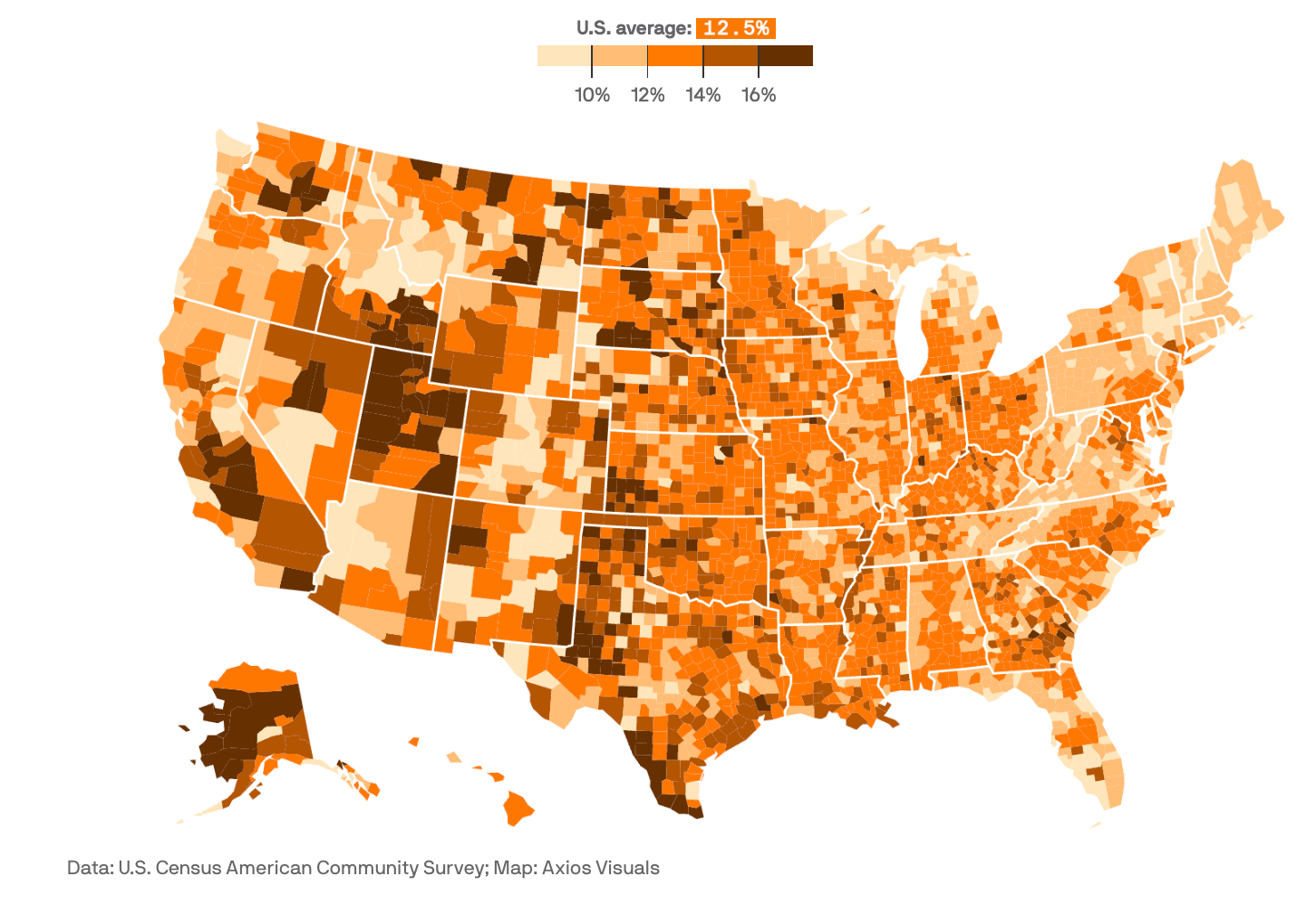
Related, Scott Kisner proposes that keeping college students local is the key reversing Massachusetts population and economic trends.
Where will those people live? The Boston Foundation’s annual housing report card will be released November 12th.
After a compromise and a City Council vote, many Boston homeowners and commercial property owners should be expecting higher tax bills.
The extent of that is still contingent on the Massachusetts legislature, which must approve the tax proposal and has been unable to move on pending climate and economic development bills.