

Boston Focus, 12.5.25
What happens when city budgets don't add up anymore?

The annual Boston Public School (BPS) budget process started a little early this year.
Mayor Wu asked all city departments to plan for 2% less than last year’s budget increase in a letter to the City Council this week. For BPS, which represents 40% of the city budget, that is not a small number. ~$31M fewer dollars than last year.
Why is this happening now?
The numbers change, but the story is the same as the past few budget cycles. Post COVID, office vacancies are up, so demand for those buildings and the surrounding activity/foot traffic is down. This means lower valuations for commercial buildings, which means fewer tax dollars. Boston has maxed out its commercial tax rate under state law, so the only way to make up the revenue gap is to increase taxes on homeowners. 10% last year, maybe 13% this year.
To avoid this, the city wants to increase tax rates on commercial properties, but it requires state approval to do so. That didn’t happen last year.
Given how boring all of this sounds, it is much easier to cast this problem as a conflict. Beacon Hill versus Boston. Mayor Wu versus State Senator Nick Collins. Business versus homeowners.
It is much harder to confront reality: the value proposition of cities like Boston, as a regional aggregator of labor and capital, has been muddied or worse.
You weren’t the only one wondering where everyone was in Post Office Square each Friday.
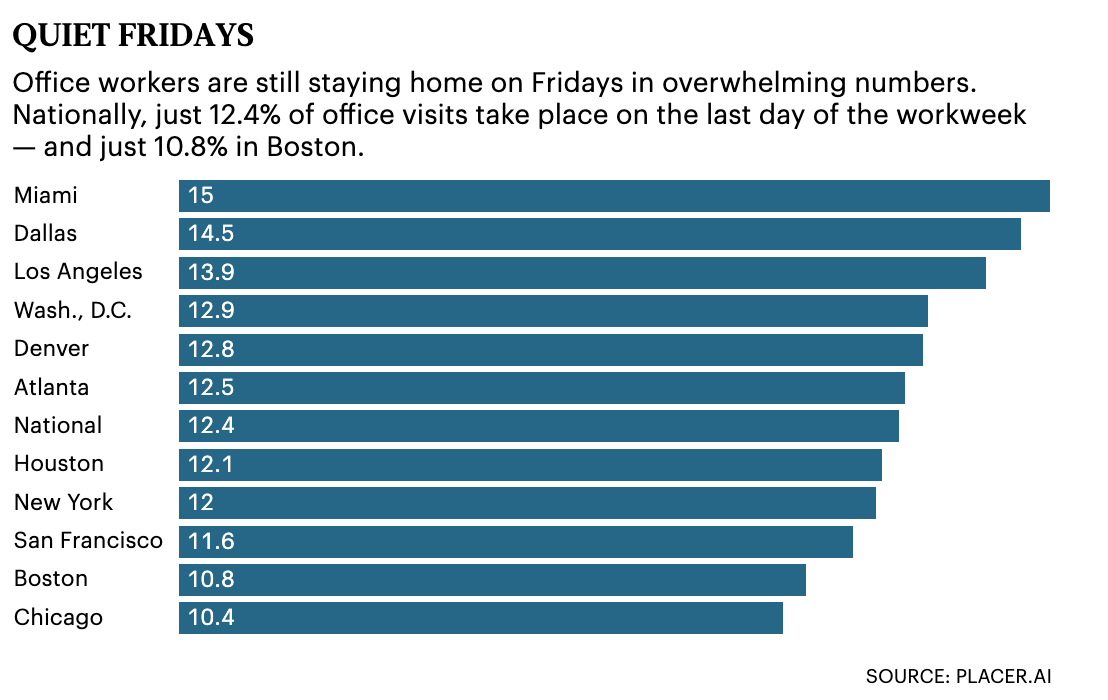
You could make the argument that commercial rates should increase (business should pay its fair share!), but you would also have to acknowledge there is a limit. If commercial valuations continue to decline, you can’t tax your way out of that problem. In fact, it would probably make the problem worse. Cue empty office buildings and jobs elsewhere. Probably not good.
You could make the argument that homeowner rates should increase (rates are lower than Dedham!), but you would also have to acknowledge there is a limit. Adding to the price of already really high housing costs will make it even more difficult to live here for current and prospective residents. Cue lots of “for sale” signs. Probably not good.
If the siren song of the SEC remains strong for college applicants, remote work is here to stay, and AI does eat some percent of professional positions, there will just be fewer people who need to live in or near Boston and go downtown to work. If that is the case, the math of the original value proposition no longer works.
Boston - and many other cities - will have to articulate new reasons to live or do business here, and have a revenue strategy to match it.
Creating new revenue streams would be politically challenging, but the alternatives - sky-high taxes or major cuts in city services - aren’t any fun either.
Rather than trying to sharpen the current revenue tools, it may be time to shop for some new ones. There is already a bill filed to open up more opportunities for municipalities to raise revenue through new taxes and fees. Nearly 5,000 American municipalities have some form of an income tax. Cities from Baton Rouge to Tacoma have their own sales tax.
The economic activity and foundation of the city has shifted; tax policy may have to shift with it.
Schools
Boston School Committee met on Wednesday. Full materials here. If you are not read up, it is worth reviewing this deck on inclusion. Serving more students with individual needs in a general classroom setting has the more significant learning, operations, and budget implications than anything else the district does now. You get an introduction to that in this story on multilingual learners. Although not on the agenda, the proposed school closures and reconfigurations got just as much attention.
The week started with a rollout of the state council’s recommendations for high school graduation. Among other things, it includes a call for assessments for courses, which could include teacher-led, project-based activities like this. The Massachusetts Teachers Association likened it to a “poisoning.” There will be a lot more debate when the Legislature weighs in. Full report here.
With enrollment declining in many MA school districts, teacher tenure and seniority could take on increased importance. The morale of MA teachers ranked lower than most states in a survey released this week.
The MA teacher of the year is Tara Goodhue from Lowell High School.
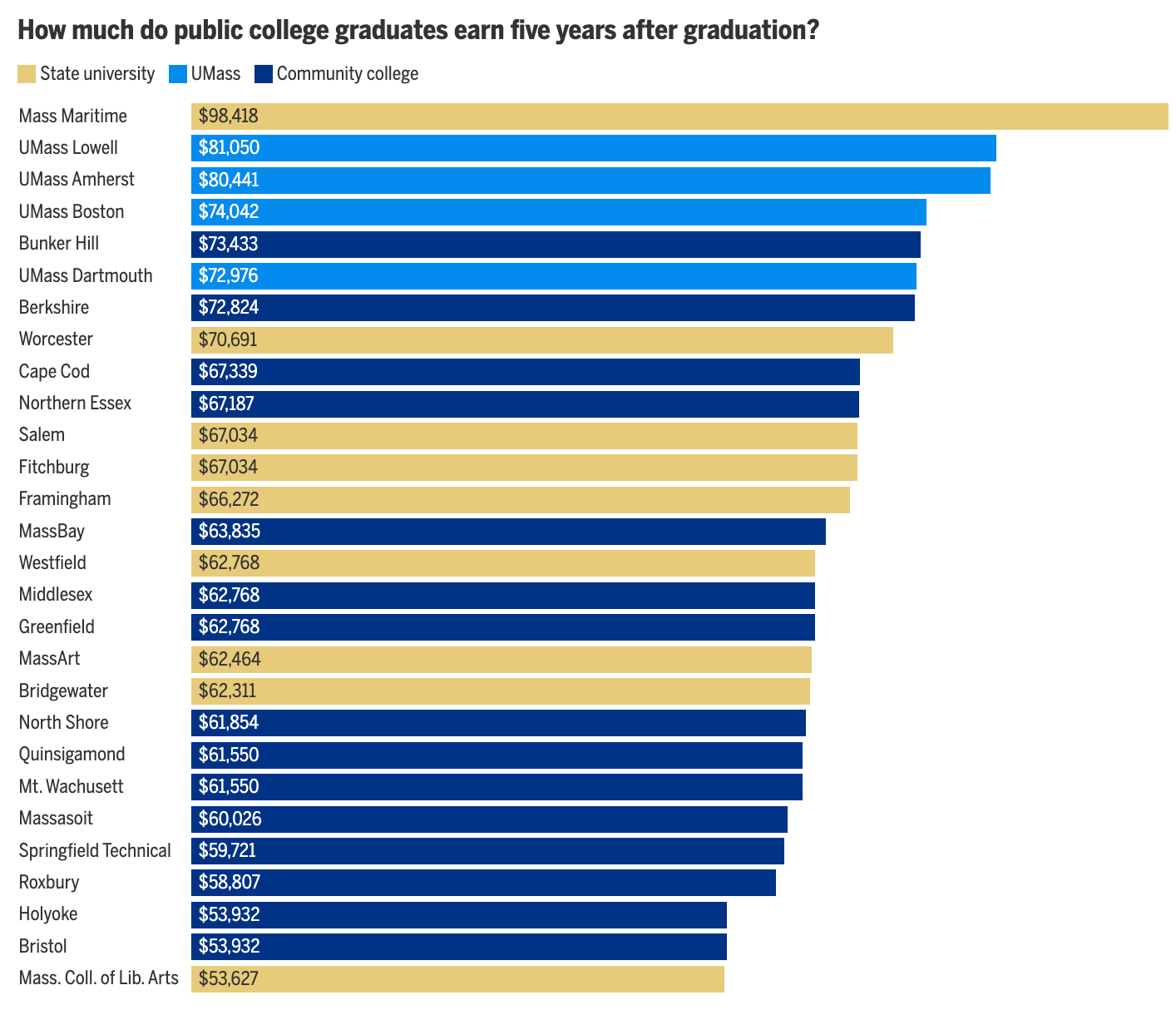
Recent data provides good news for seafarers and the UMass system, less good news for the state’s community colleges.
I don’t usually call out think pieces, but a New York Times newsletter lede this week is worth reading just to rebut it. Yes, children’s mental health issues have increased and/or we have gotten better at diagnosing them. No, this is likely not because of education policies that were passed 24 years ago, and undone 13 years later. In addition to the standard asterisk around causation vs. correlation, the data says that more kids are getting higher grades, graduating from high school, and enrolling in college without demonstrably longer school days or more homework than they did 20 years ago. So perhaps the stress the author cites is coming from elsewhere?
What will be the impact of the closing/reorganization of the US Department of Education on special education?
Other Matters
A good summary of the 12 potential ballot questions that met the signature requirement, but still need survive the Legislature and usual legal challenges to be on the ballot in 2026.
Thanks for the engagement and feedback on my Boston Globe op-ed. The interest and thoughtful questions confirmed for me that the topic - student assignment - deserves a public airing.