

Boston Focus, 2.27.26
Are the right pieces in place for more Boston kids to go to college?

Unlike Massachusetts, Boston students’ planned postsecondary enrollment shows no signs of long-term decline. State data actually shows an increase and leveling since 2021.
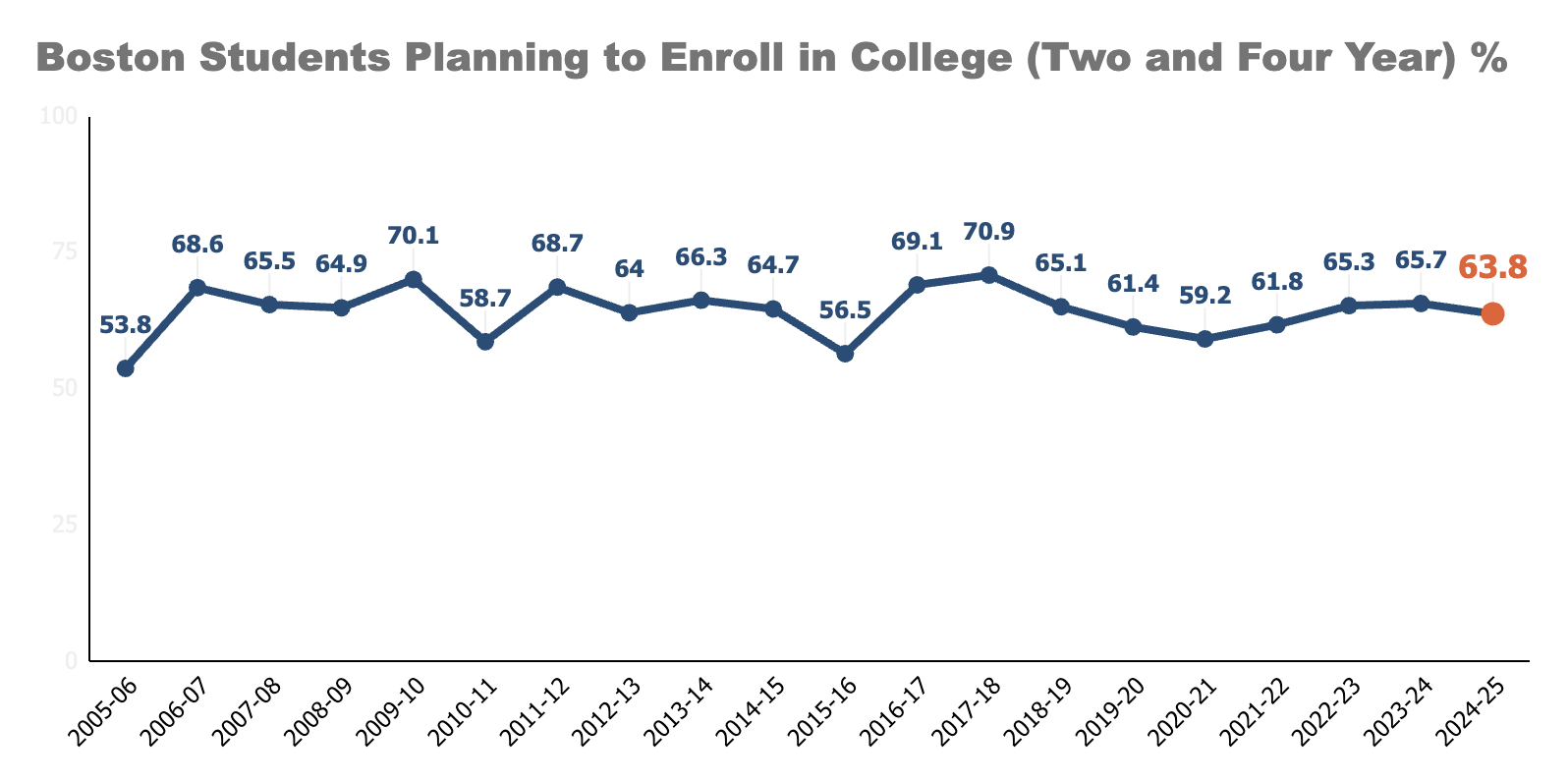
Good news!
There are no clear explanations for the big swings of past years. Whether it was programming, cohort differences, or data integrity, planned enrollment in 4-year private and public universities drove the volatility, ranging from 35.4% to 16.4% in given years. Two-year enrollment has been comparatively consistent.
The last 4-5 years of data have now settled into a consistent range, as well as enrollment by sector.
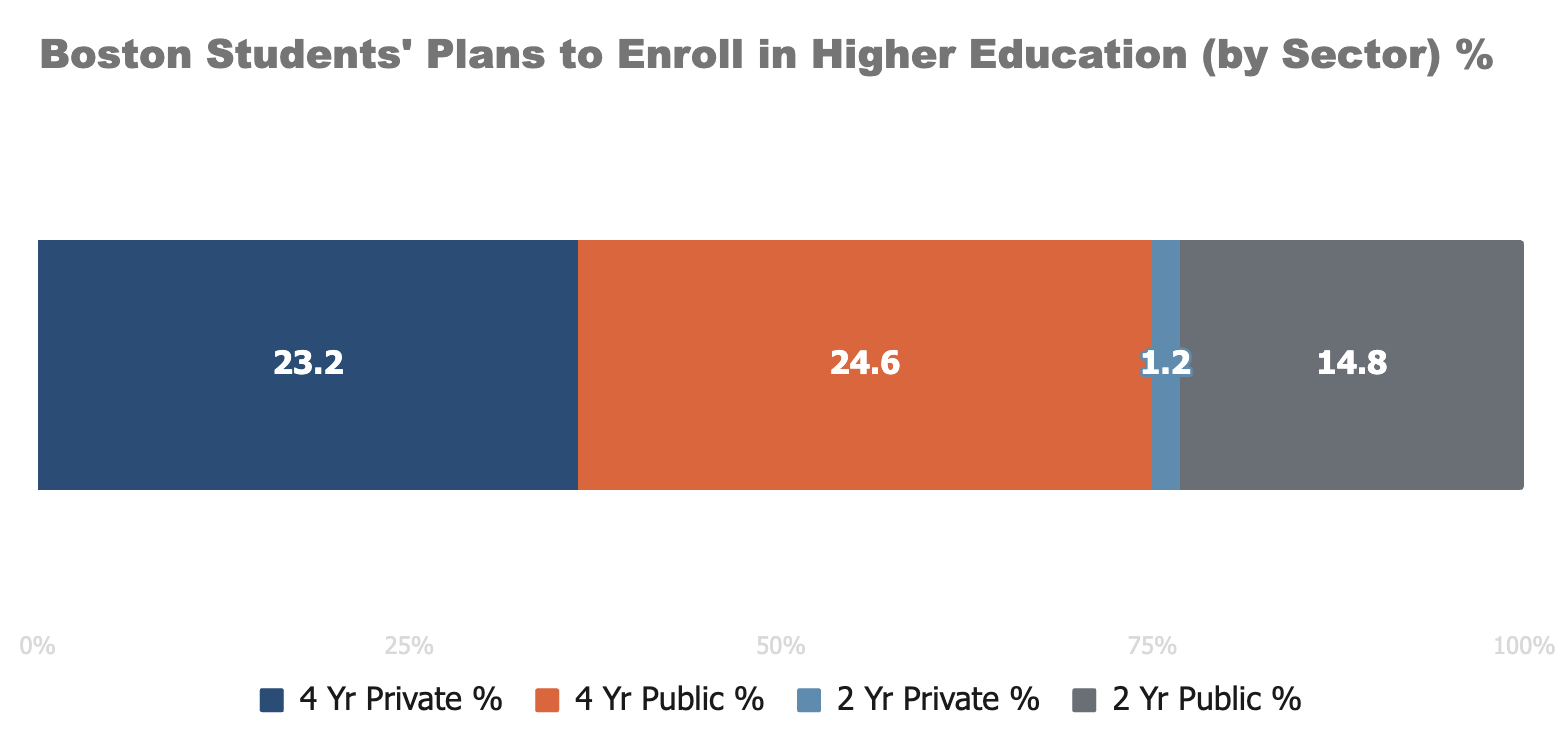
This consistency - in light of state data - would be something to celebrate if it could be explained and sustained. But without any recent major reforms or research in Boston high schools, there is only one plausible reason.
Exam schools.
The exam school effect on the general average is particularly stark when you focus on four-year colleges, which are more selective.
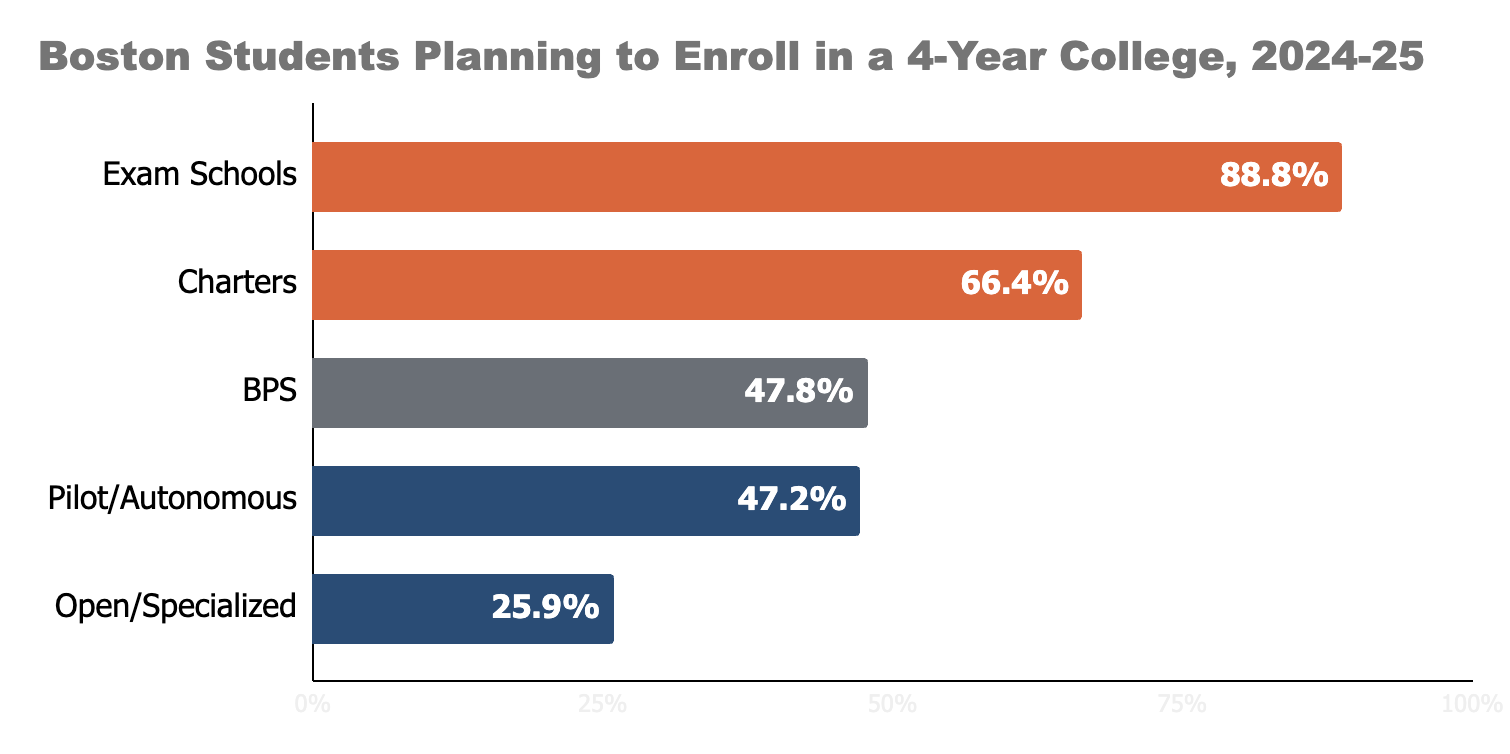
Exam schools have very high college matriculation rates and enroll significantly more students than most Boston high schools. Those three small orange dots right below create a big skew.
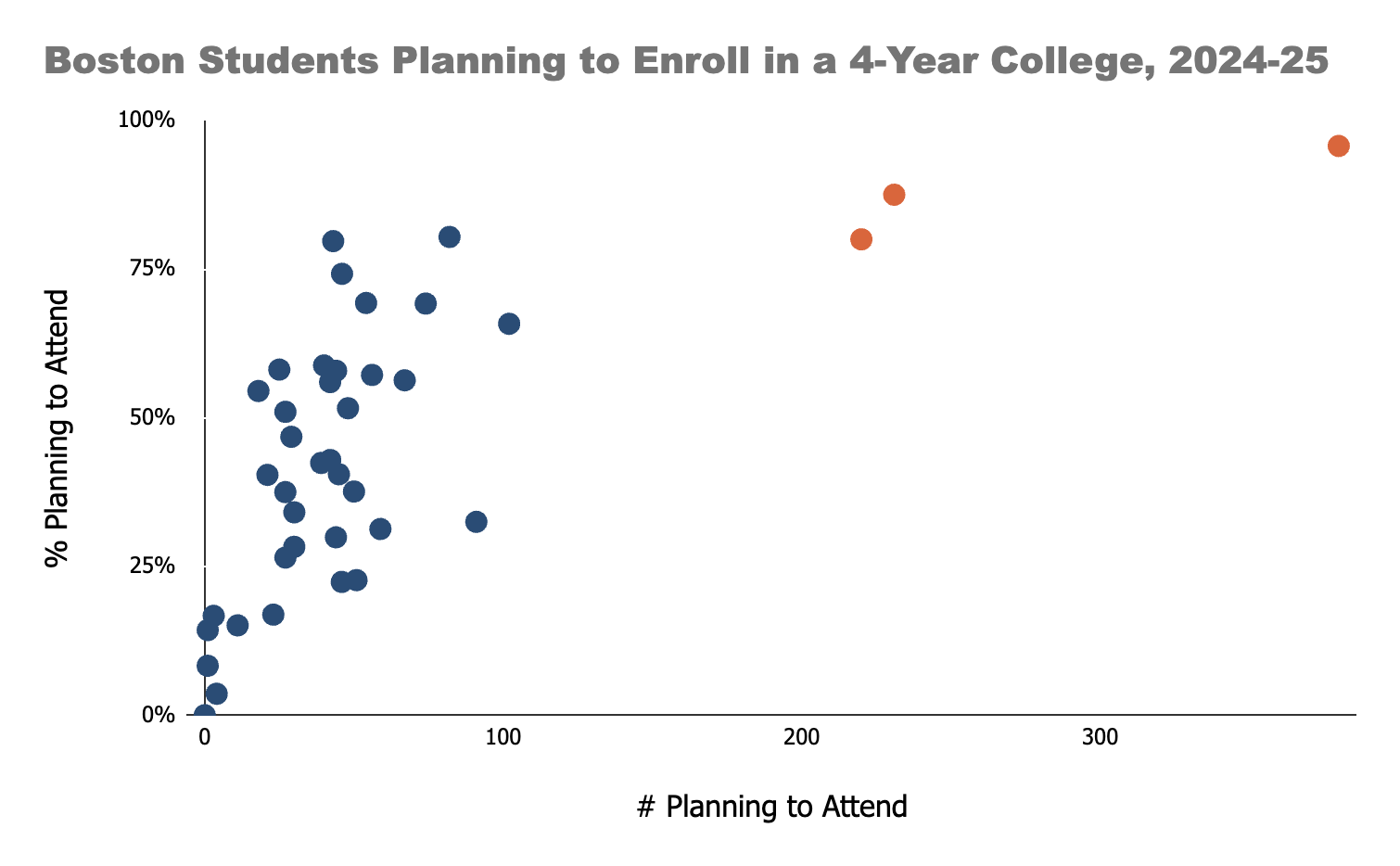
The result? The three exam schools are responsible for nearly half of Boston students planning to enroll in a four-year college.
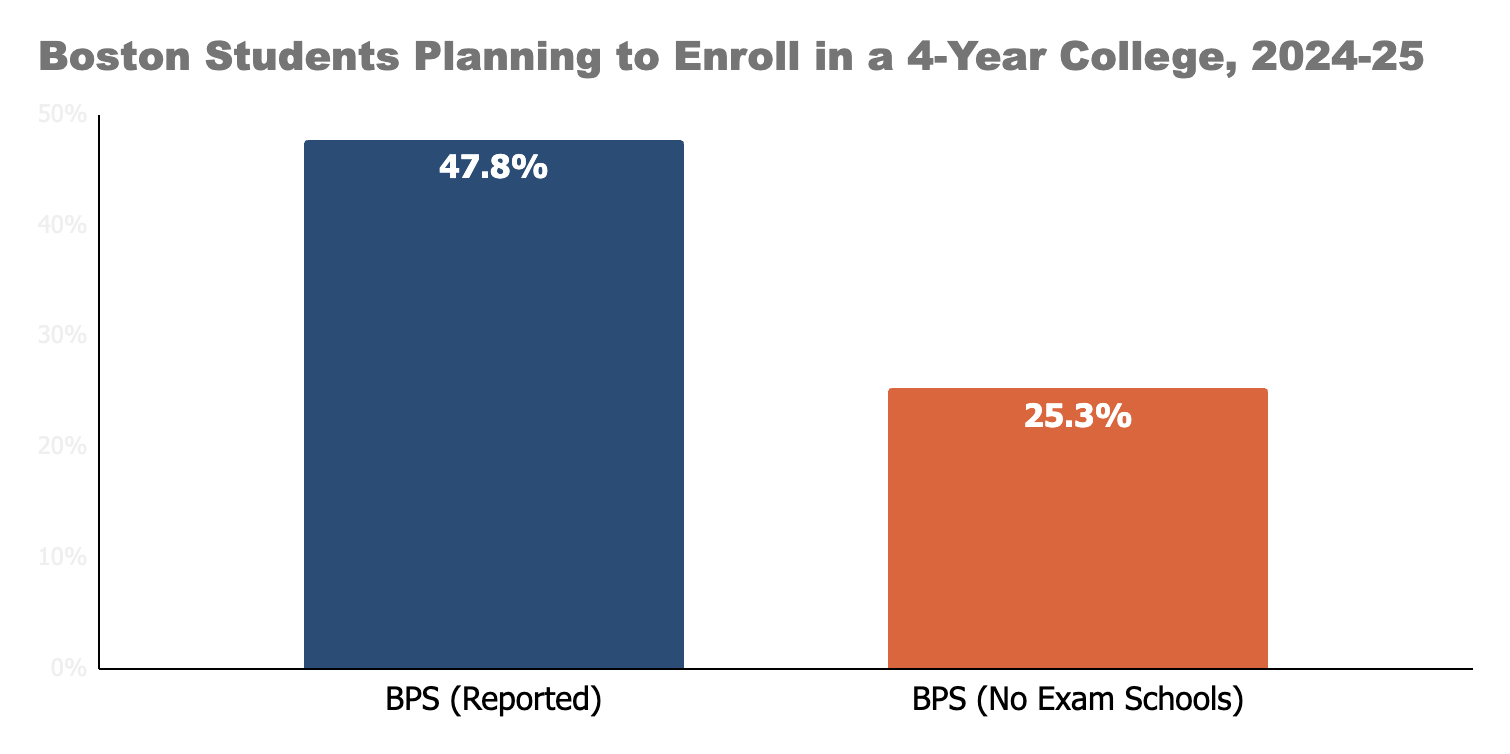
This is not news for anyone who follows Boston schools. Nor will it likely change anyone’s mind about exam schools. The graph above is evidence for someone who believes that exam schools are vital for the system, or could be a talking point for someone else to argue that they should not exist at all.
But they do, and accounting for that is the unfinished work of the multiple rounds of school reconfigurations, moves, and closures over the past decade. In 2015, the exam schools were the city’s only 7-12 schools, and PK-6 schools did not exist.
Today (and including announced/future plans) +70% of BPS schools offer grades PK-6 or grades 7-12. Middle schools no longer exist. A few early education centers remain. A handful of K-8s serve as neighborhood hubs and outlets for programmatic needs, and the few traditional 9-12 high schools are largely capital constrained.
This is a remarkable shift, which was intended to limit transitions for families and give schools more scale and resources to develop effective school models alongside exam schools. Strengthening non-exam high schools was a particular focus.
With a lot of time and effort, the pieces were put in place.
Time will tell if it delivers.
Schools
White Stadium is slated to be more expensive than comparable projects. Will that also be true for Madison Park?
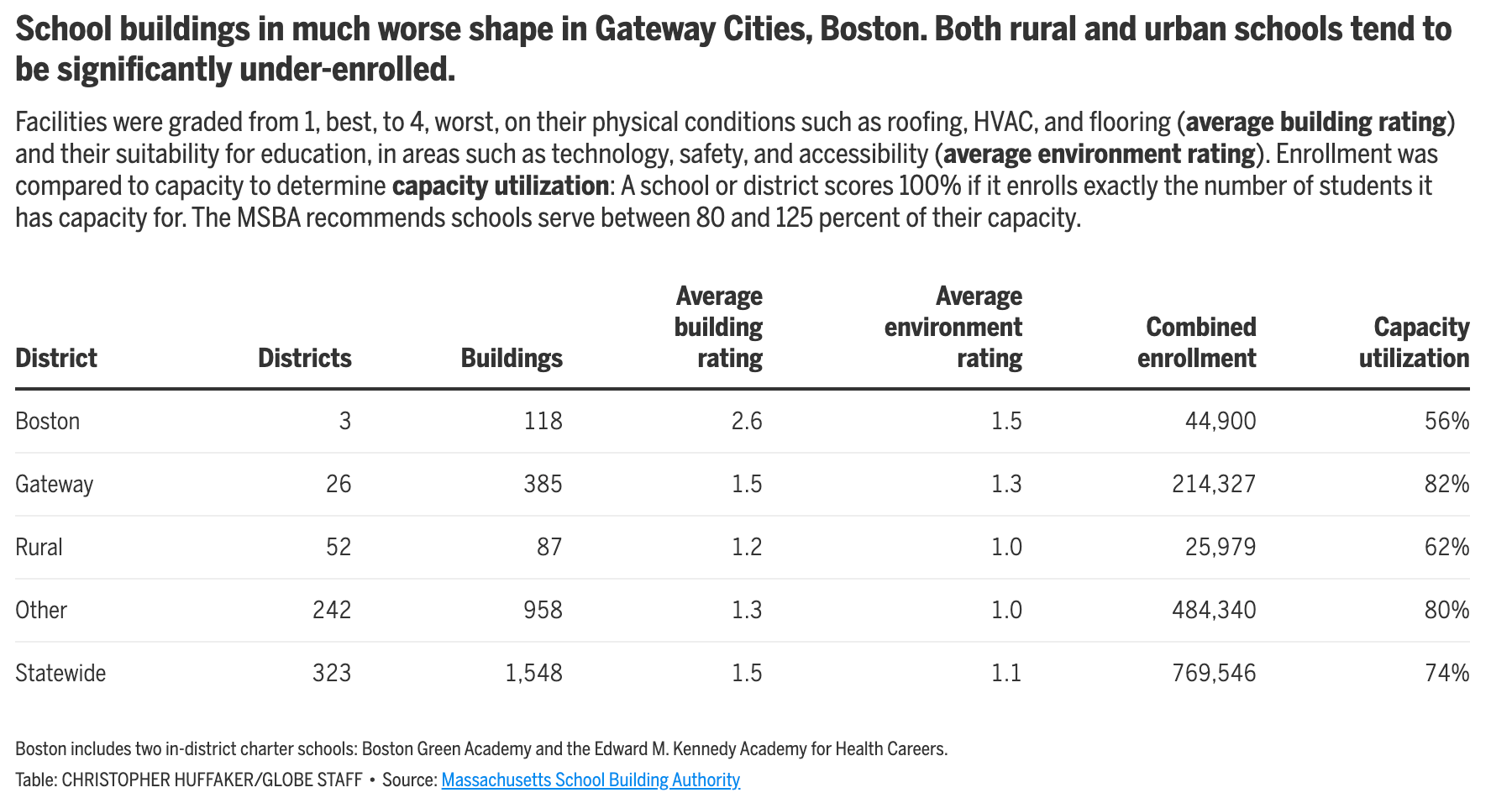
Boston’s school buildings reflect the state-wide trend for lower income districts: older and underutilized.
Careful with clickbait on teacher attendance - staff attendance was higher at Boston schools on Wednesday (~97.5%) than the annual average (94%).
A big grant to EdVestors will expand Boston kids’ career readiness.
Despite being out of school for at least 11 school days, there was a lot of Massachusetts education news and policy developments. Chicopee is piloting bus safety cameras. Is the Springfield empowerment zone winding down? The state’s aggressive response to combat antisemitism in schools gets a full treatment. A new inspector general’s report calls for reform in special education transportation funding. The path to universal preK in Gateway Cities is rocky. A bill to support capital improvements in higher education is moving. Want to be a teacher and earn as much as a pediatrician? Move to Provincetown.
And a lot of school districts - like Fall River - won’t be back in school until Monday.
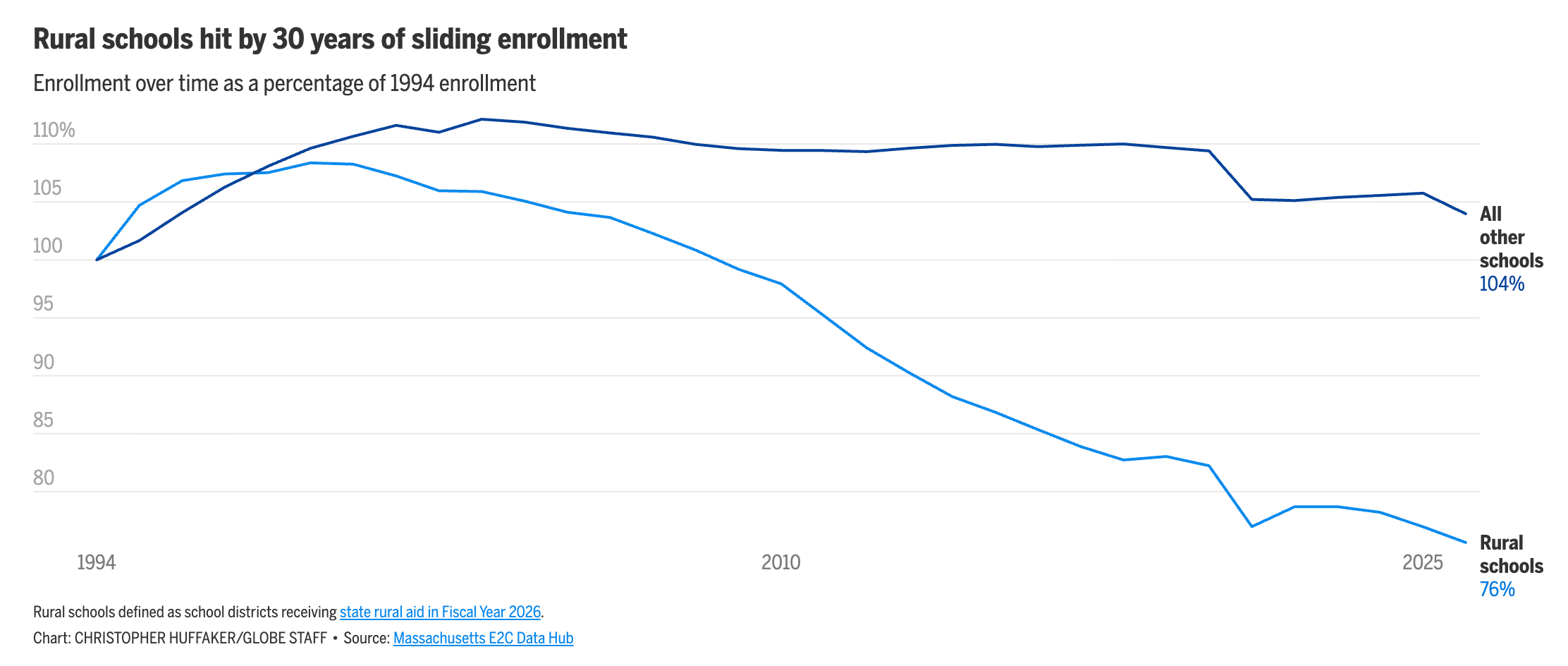
Many years in the making, but Massachusetts rural school districts are feeling the squeeze of enrollment decline.
The Board of Elementary Secondary Education also met this week. Full materials here. An interesting measure was introduced to potentially curtail future illegal teacher strikes.
And, with bills in conference committee, a new law requiring evidence-based literacy curriculum and practices seems imminent. Here’s the counterpoint.
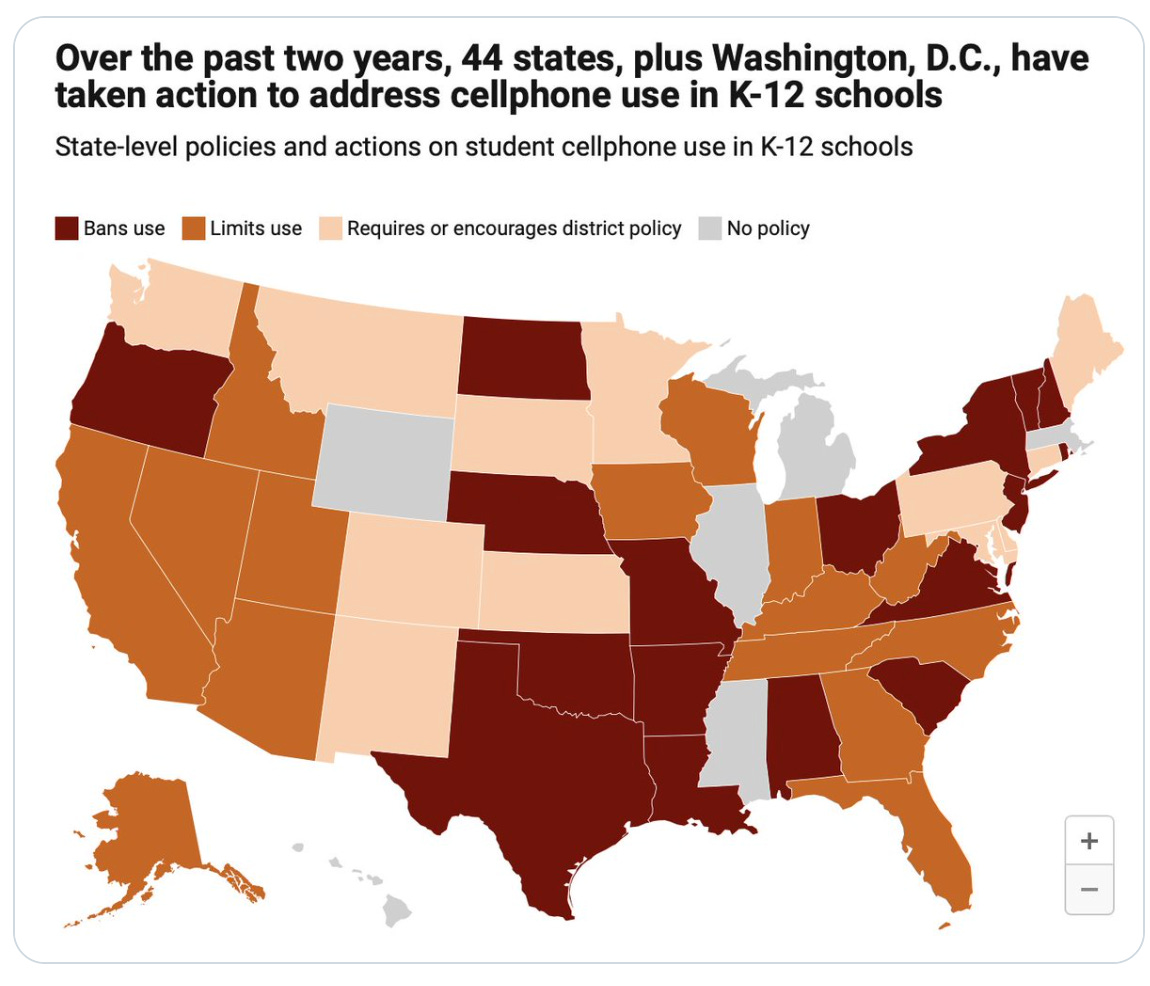
Will the legislature also have time to pass a school cell phone ban? Another comprehensive study links the bans to improved school outcomes, particularly for girls. Maybe Massachusetts shouldn’t copy Mississippi on this one?
Families often trust report cards more than standardized tests. But what if kids are cheating?
If a Pew survey is accurate, half of students’ graded work is being produced by AI. Market and political analysis is aflutter about the unknown impacts of AI, but we probably already know it could be bad for student learning. One of North Star’s high schools in Newark, NJ provides an excellent example of how to manage students’ responsible adoption and usage of AI tools.
Other Matters
The Sports Betting Alliance responded to my Boston Globe oped with one of their own and some carefully leaked poll results. Their argument: online sports gambling is legal and most people are OK with that.
True, but not my argument (and not really an argument at all). It is a classic political tactic to state something true and hope that nobody notices you changed the subject. Unfortunately for these lobbyists and their clients, everyone has noticed the incessant ads, betting scandals, the explosion of youth gambling, and losses piling up for those suffering from addiction.
If the subject is taxation and regulation, they do not have a policy or moral leg to stand on.
If you agree, you can do your part by emailing State Senator Barry Finegold at Barry.Finegold@masenate.gov. Senator Finegold is chair of Joint Committee on Economic Development and Emerging and that committee has until March 6 to report favorably on Senator Keenan’s Bettor Health Act, which addresses the economic, social, and health harms of online sports gambling.