

Boston Focus, 2.28.25
AP (Advanced Placement) and the limits of ap (average performance)

Massachusetts is leading the country in Advanced Placement (AP) scores and access.
That’s a good thing.
No curriculum or assessment lacks limits or detractors. There has been movement amongst some elite independent schools to stop using APs. The course and testing requirements can crowd other courses or conflict completely with programming (International Baccalaureate, for example). The College Board, which administers AP, is not everyone’s cup of tea.
But AP tests continue to be widely administered (~35% of American high school graduates will take one) and to be widely accepted as signal of college readiness or for actual college credit.
For good reason. AP classes and assessments are highly complex, formulated through years of research and hand-graded by committees of college faculty and highly experienced and skilled high school teachers. Clocking in at three hours with tasks ranging from translating the Aeneid to singing with perfect pitch, an AP test is no joke, and it takes a year of really good instruction and a lot of work to pass one. [AP tests are graded 1-5, with 3 considered passing.]
So, it is definitely an accomplishment that the Commonwealth has not only country-leading passing rates, but also participation and passing rates increasing across all subgroups.
The headline for Boston’s AP scores (2023-2024 here) looks good at first. With 60% of participating students scoring a 3 or more, Boston trails Massachusetts by a bit, but outperforms the national average. Strong, particularly for an urban school district.
But what the headline does not tell you is that Boston’s AP results are heavily skewed by race. The number of students taking or passing AP exams does not reflect the overall demography of the district.
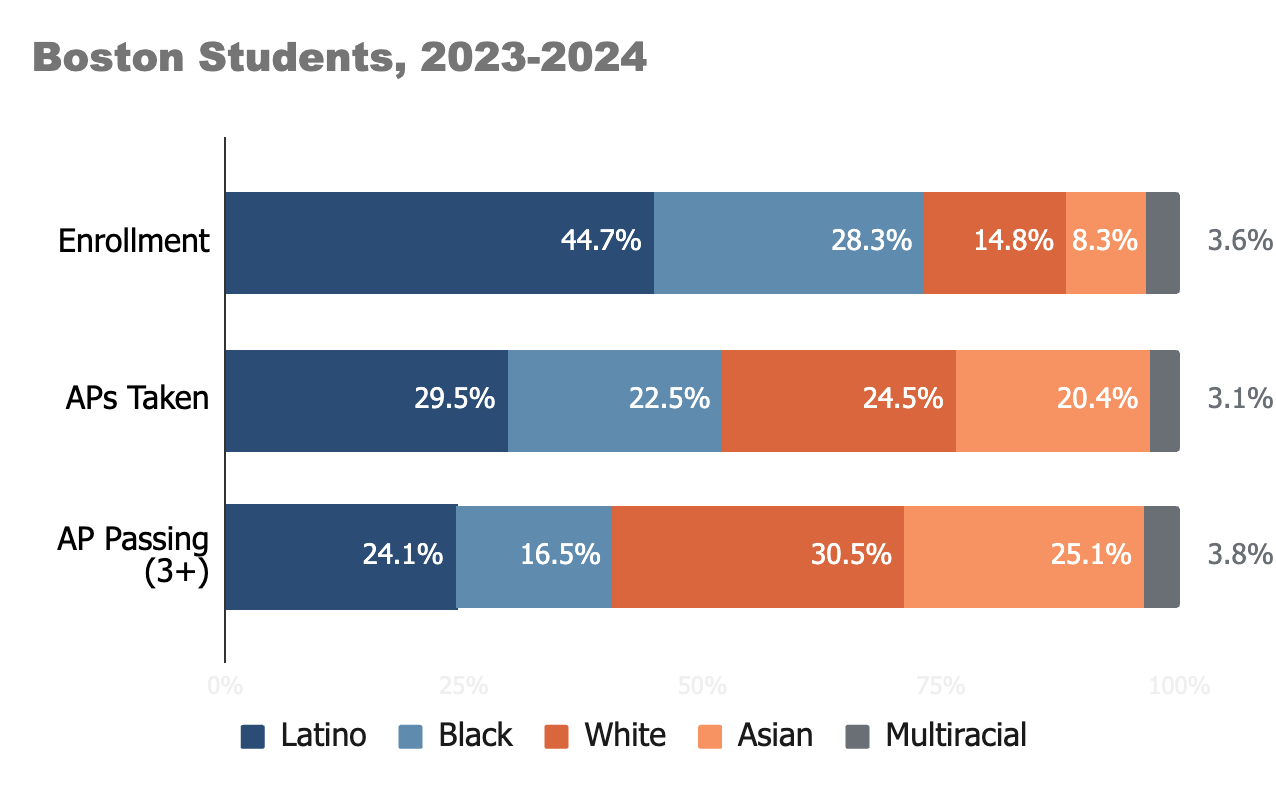
White and Asian students compromise less than one-quarter of BPS students, but greater than half of those who passed AP exams.
Race and other subgroups pale in comparison, however, to the impact of Boston’s exam schools on AP data. Students at Boston Latin, Boston Latin Academy, and the O’Bryant not only take AP exams at a significantly higher rate than their peers; these three schools are responsible for 91% of passing AP scores.
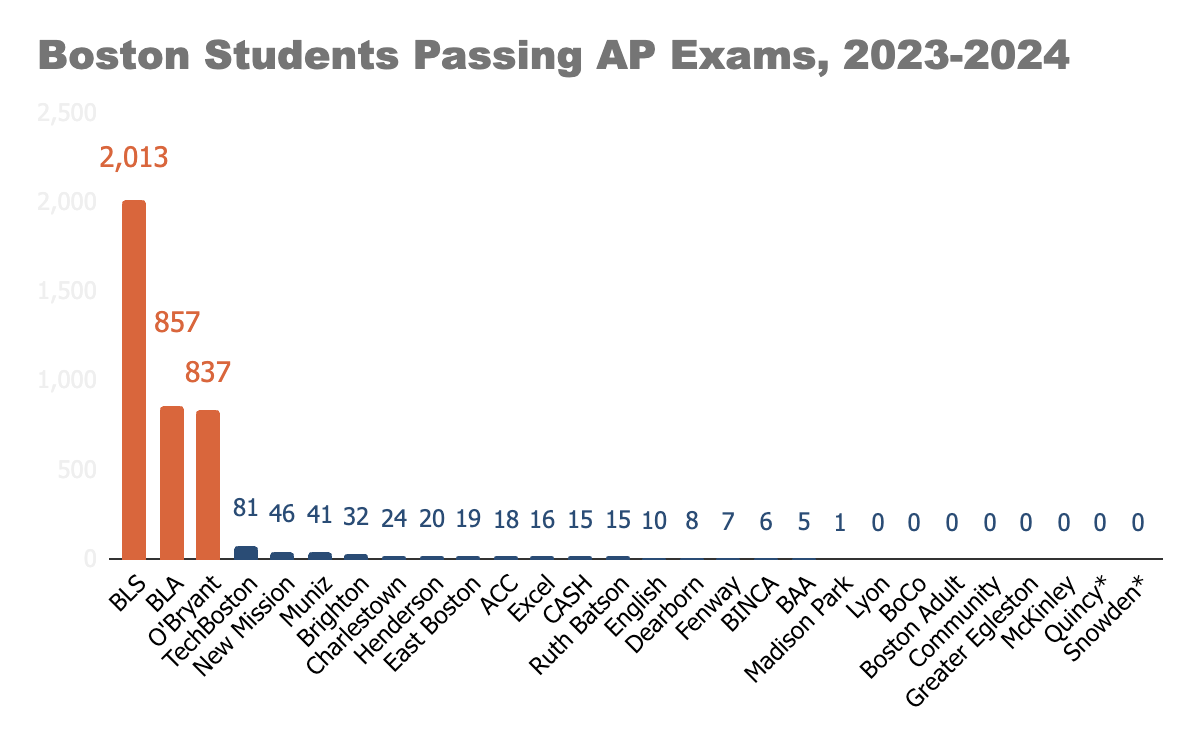
Remove the exam schools, and the city’s AP passing rate drops 37 points.
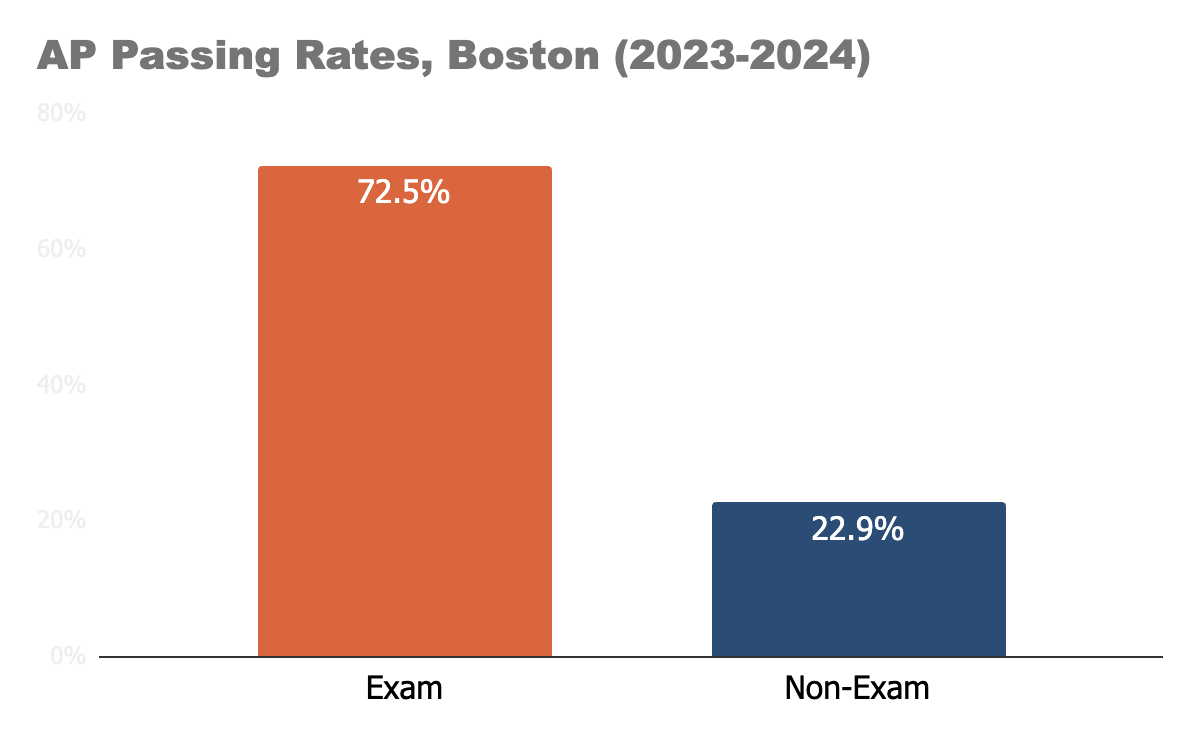
Of course, it is not reasonable to “remove” exam schools from averages. They are a part of BPS, and every school in the district counts for all the various measures needed for the city, state, and federal government.
But it is reasonable to interrogate averages to raise questions. Without AP as a proxy, there is a burden on the district and non-exam high schools to prove their students are getting access to curricula and assessments that will make them college or career ready. Adopted in Boston nearly 4 years ago, MassCore standards are supposed to address this starting with the Class of 2026.
Time will tell if that is fair substitution for AP.
Schools
Boston School Committee met this week. Full materials here, a good meeting summary here. The emergent/new issue was applying for state funds to support the renovation of Madison Park, which would be expensive and would take a while (with no guarantee of funding).
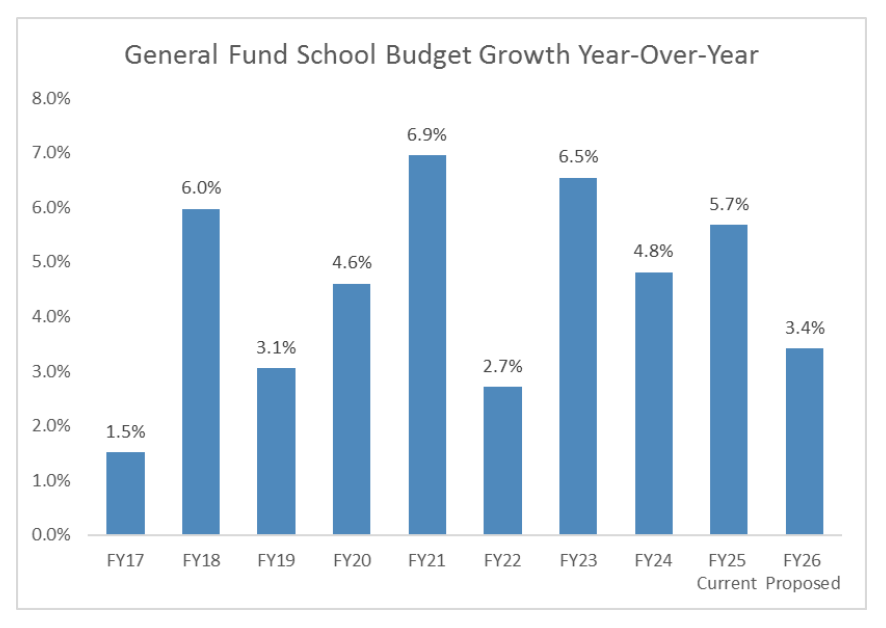
BPS budget discussions continue next week. Boston Municipal Research Bureau (BMRB) summarizes what has been released so far.
The highest-profile BPS initiative, the renovation of White Stadium, didn’t make it on the agenda but is getting no shortage of attention from the media.
No discussion by appointed members on the proposal to reinstate school committee elections,
Very busy Board of Elementary and Secondary Education meeting this week. Full materials here. After months of advocacy, there was a split vote on charter school expansions; the first step in determining a new “competency determination” for high school graduation; and reform for admissions to vocational schools.
An interview with one of bill sponsors seeking a legislative ban on cell phones in Massachusetts schools. Additional data/supporting arguments here.
After a contentious hearing investigating anti-semitism in Massachusetts, the Massachusetts Teachers Association removed materials from its website.
Updated projections show the number of annual American high school graduates in decline. But, it’s a bumpy ride, with some states growing, while others see decreases. MA is in the latter group.
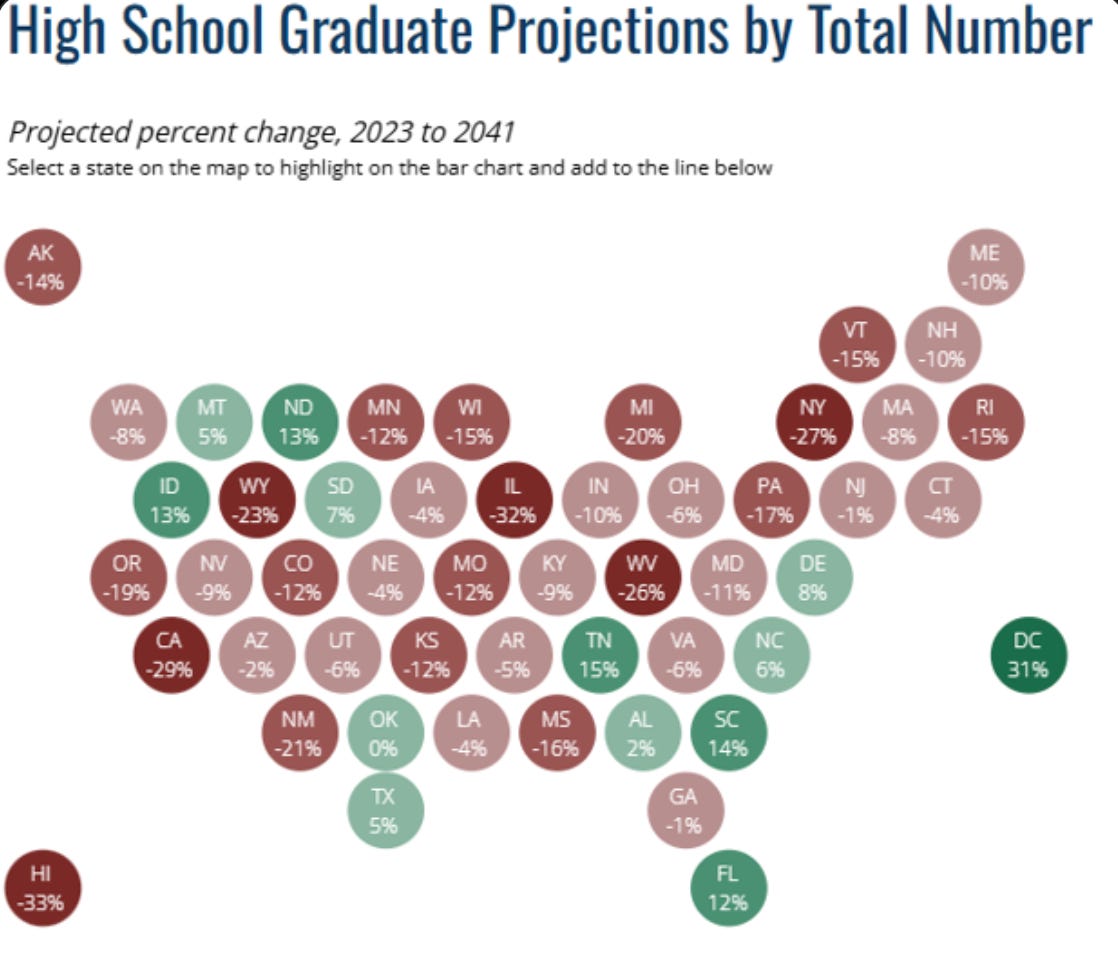
Other parts of the country aren’t waiting and seeing. Pittsburgh, PA and LA are rolling significant school closure plans.
The Trump administration gave American schools until next Tuesday to end diversity initiatives and was promptly sued. No redress yet for the suspension of the head of the NAEP (the “Nation’s Report Card”) or the cancellation of testing for 17 year-olds.
Federal Medicaid cuts could affect Massachusetts school budgets. Among other things, Medicaid plugs a hole in the MA budget, which has grown significantly, in part, due to rising health care costs.
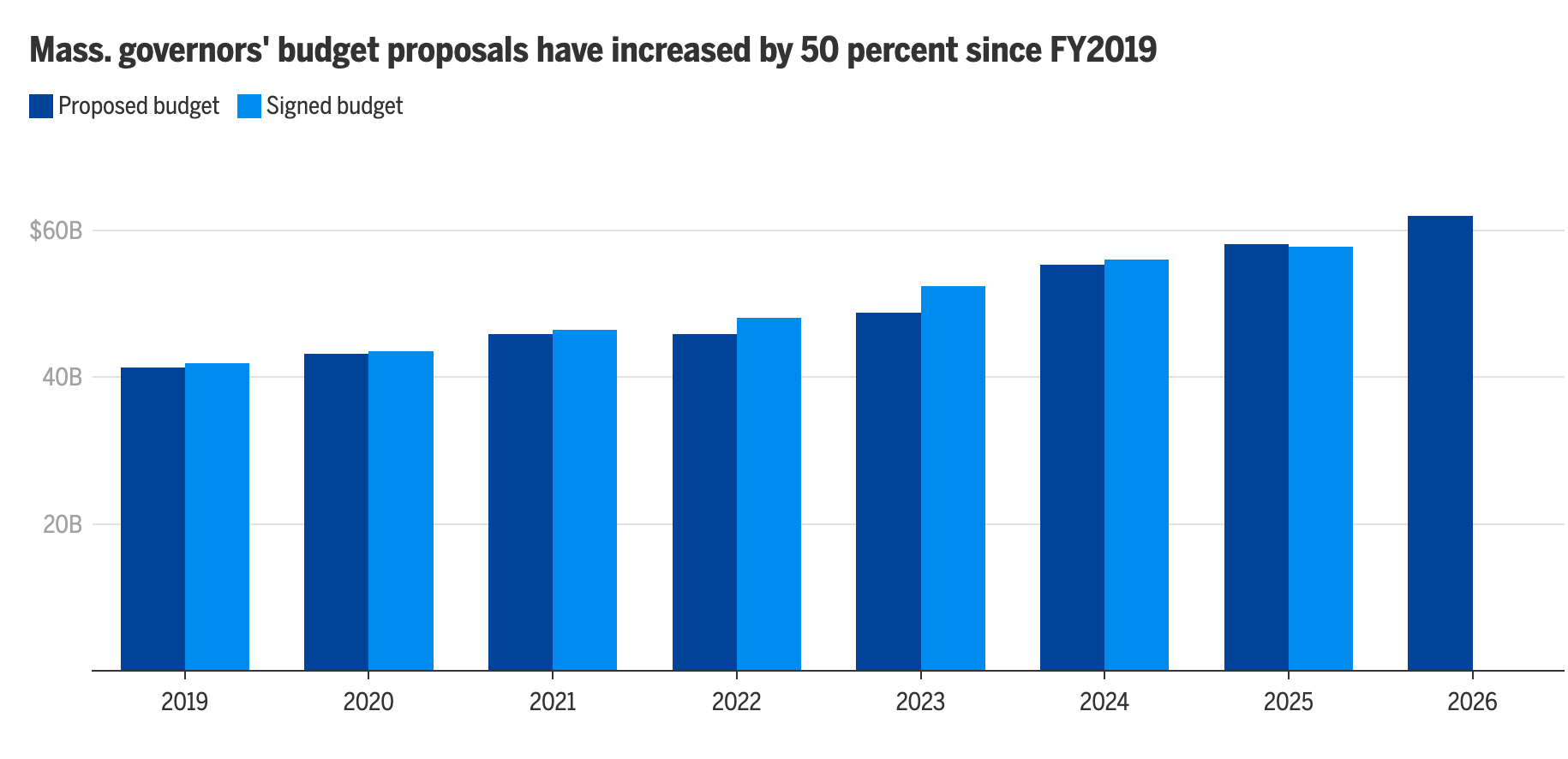
There are debating studies and theories about the impact of preK, but here is a new wrinkle. PreK may increase earnings, for the families enrolling their children.
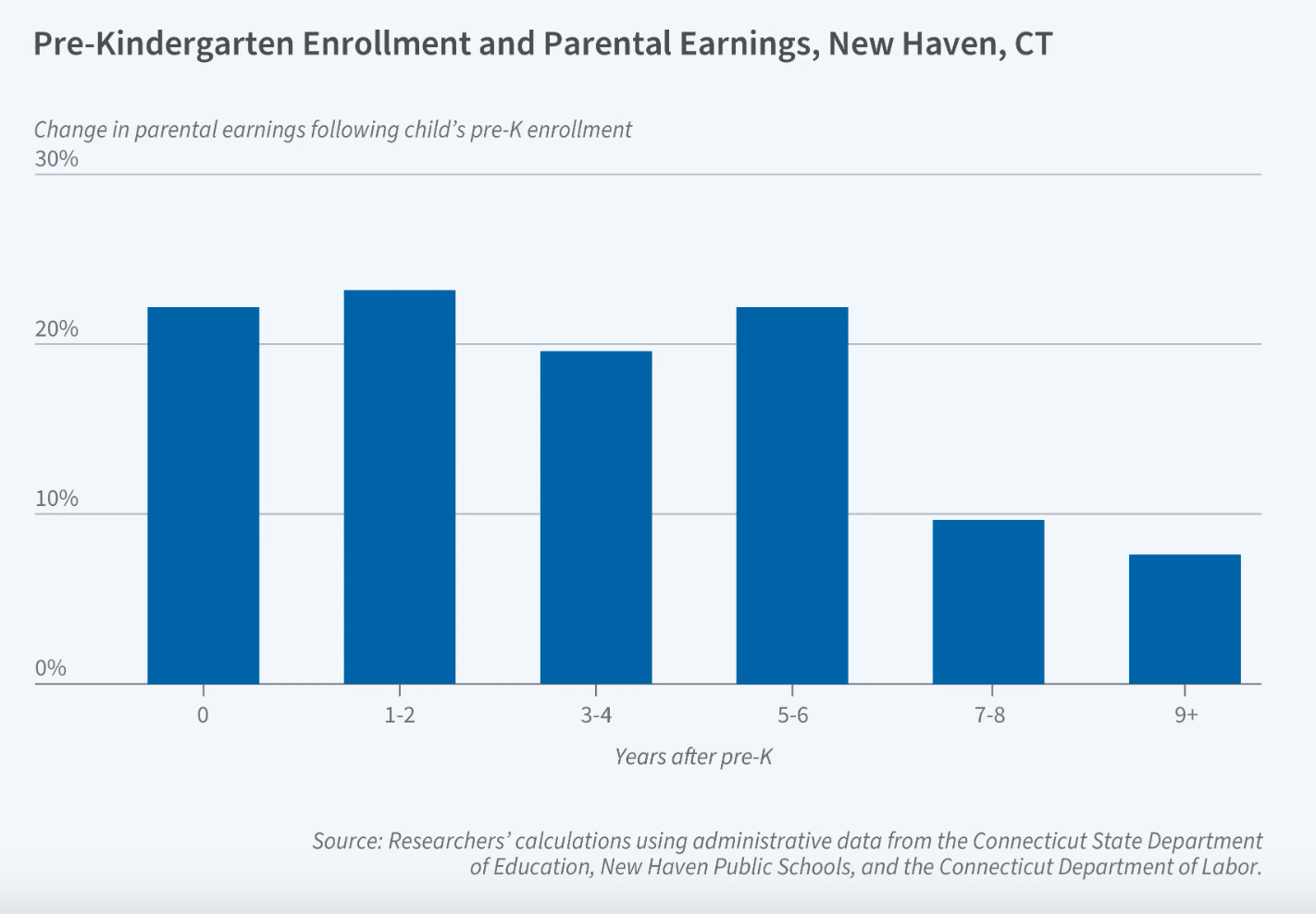
Other Matters
In previous times of economic transition or downturn, it was common to see homes go into foreclosure or up for auction.
This raises short term concerns around city revenue, but it raises longer term ones, too. Governments and markets know how to intervene when there is a vacant lot, a vacant home, or even an inactive strip mall.
What do you do with a million square feet in the middle of a city?
This will not affect this year’s budget cycle, which includes the first citizen-selected budget priorities and projects: food, rats, reentry, rent, food again (but from gardens), and benches.
There are many leading indicators, but the lagging ones around college acceptance and success and adult income (MA now can track that) will be determinative. I find this interesting less so because of the admissions changes, and more so as an extension of the "elite illusion" research by Angrist et alia that questions the treatment effect of exam school attendance.
I don't believe they do - just 3+/passing.