

Boston Focus, 3.7.25
Urban school systems can struggle to keep students, but they still have to be good at counting them

There are two things that contribute to student enrollment decline: fewer kids coming in and more kids going out.
The latter is attrition, the percentage of students that leave a school system in one grade and do not return for the following grade. Across the country and in Massachusetts, urban school districts - with more students with lower incomes, less housing stability, newcomers, etc. - tend to have higher rates of attrition.
Scrolling through the most recently released data, Boston’s attrition aligns with other cities in Massachusetts, with some local color. After increasing nearly every year and through the pandemic, Boston’s attrition rates have begun to decline.
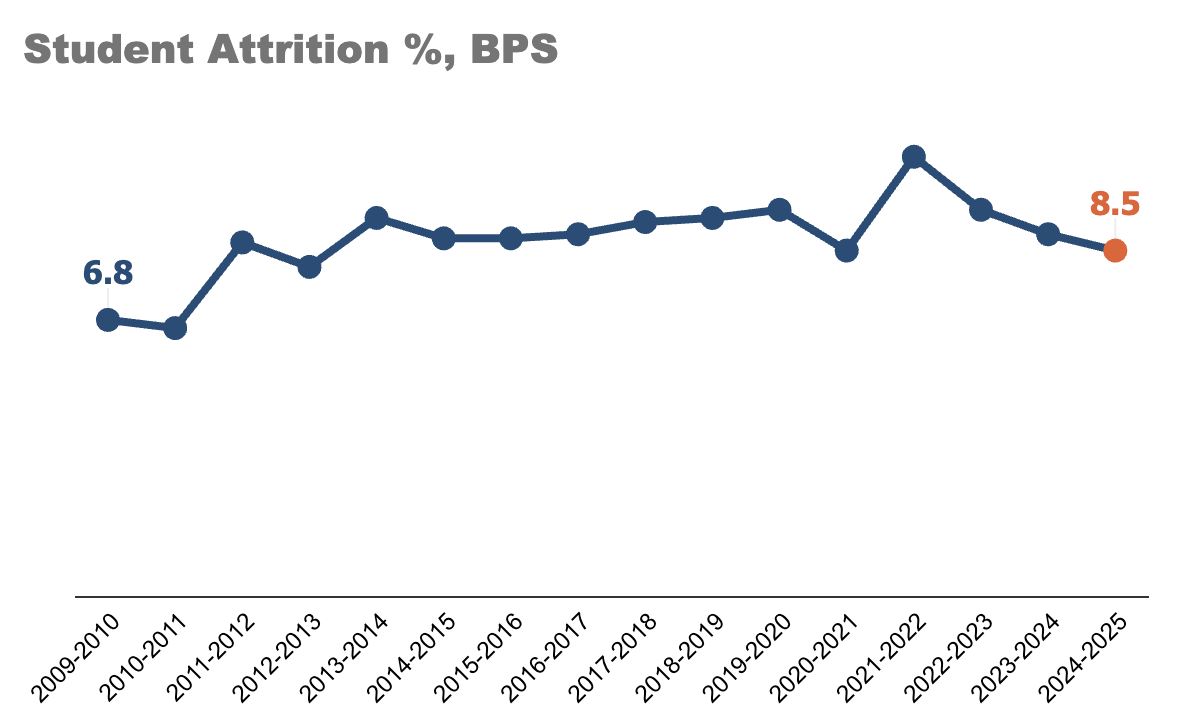
A big driver of this trend was 4th and 5th grade attrition. Rates of students leaving BPS at the end of these grades rose dramatically exactly when Boston’s charter school sector doubled. Every new charter expansion granted between 2010 and 2016 added middle or high school seats, and those new seats dovetailed with more BPS students leaving at the natural entry points for many charter schools.
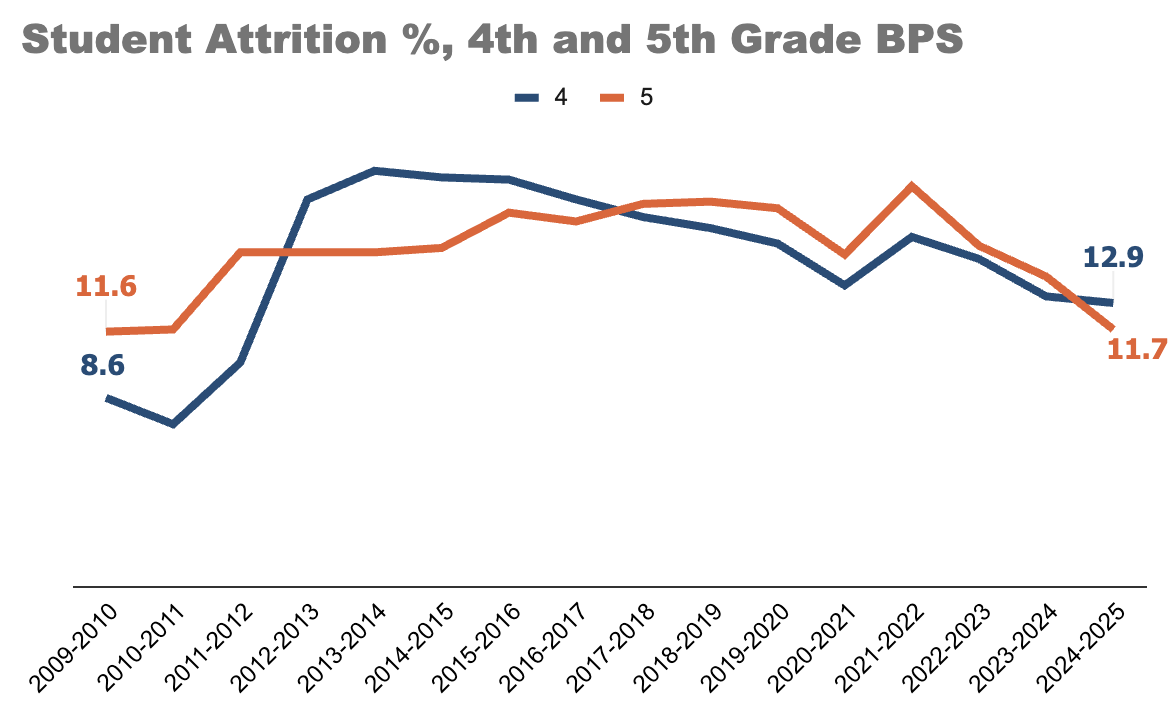
At the same time, attrition rates for Black students in these grades spiked; in some years in this span, one-quarter of all BPS Black students in these grades attritted.
Something very different is happening in 6th grade in BPS. While attrition in all other grades has recently declined, it has nearly doubled here.
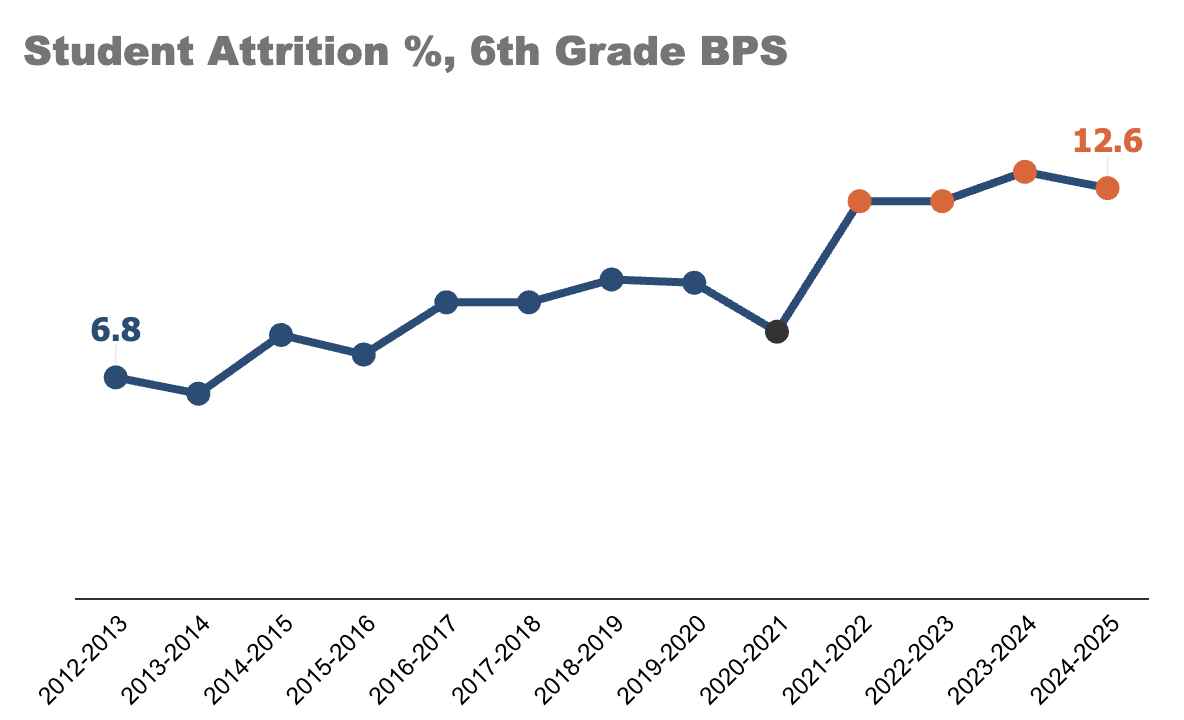
This was not the intended or expected result of recent city policy. Over the past decade, the city has systematically reconfigured BPS schools to be primarily more PK-6s and 7-12s, often citing predictability and less transitions as a way to keep more families. With much of that work done, we should be seeing less attrition, not more.
What is driving this? The data is pretty clear: white students.
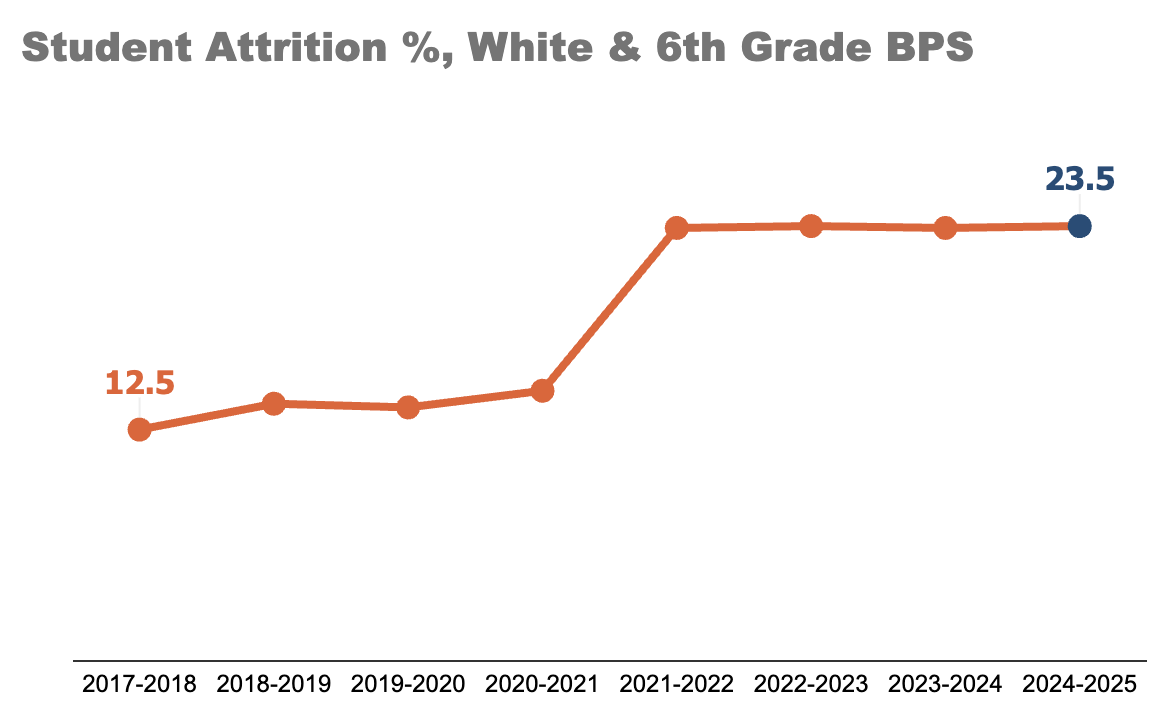
Although it may be natural to ask where those students are going, it is more clear where many are not. Three BPS schools for whom there is a more limited chance of exam school enrollment posted attrition rates of 59.4%, 70.6%, 78.6%.
As I wrote last August in the Boston Globe, families of different socioeconomic and racial backgrounds have chosen to leave BPS. With a stable charter sector and unsuccessful legal challenges on exam school admissions, there are not policies to change, but trends to monitor.
Boston does not have control over its enrollment. But with federal funding uncertainty, calls to address state education funding, and still a master facilities plan to account for, the city needs to have an understanding of what enrollment is and will be.
Schools
Boston School Committee met on Wednesday. Full materials here. The FY26 budget continues to be the focus, with a central office summary and the release of a 260-page budget book. One more hearing before the budget vote later this month.
New development in the new building needed for EMK Health Career Academy’s expansion. Rather than building a new school, the city has put a bid for it to be built and leased back. Potential sites include the closed Carney Hospital in Dorchester.
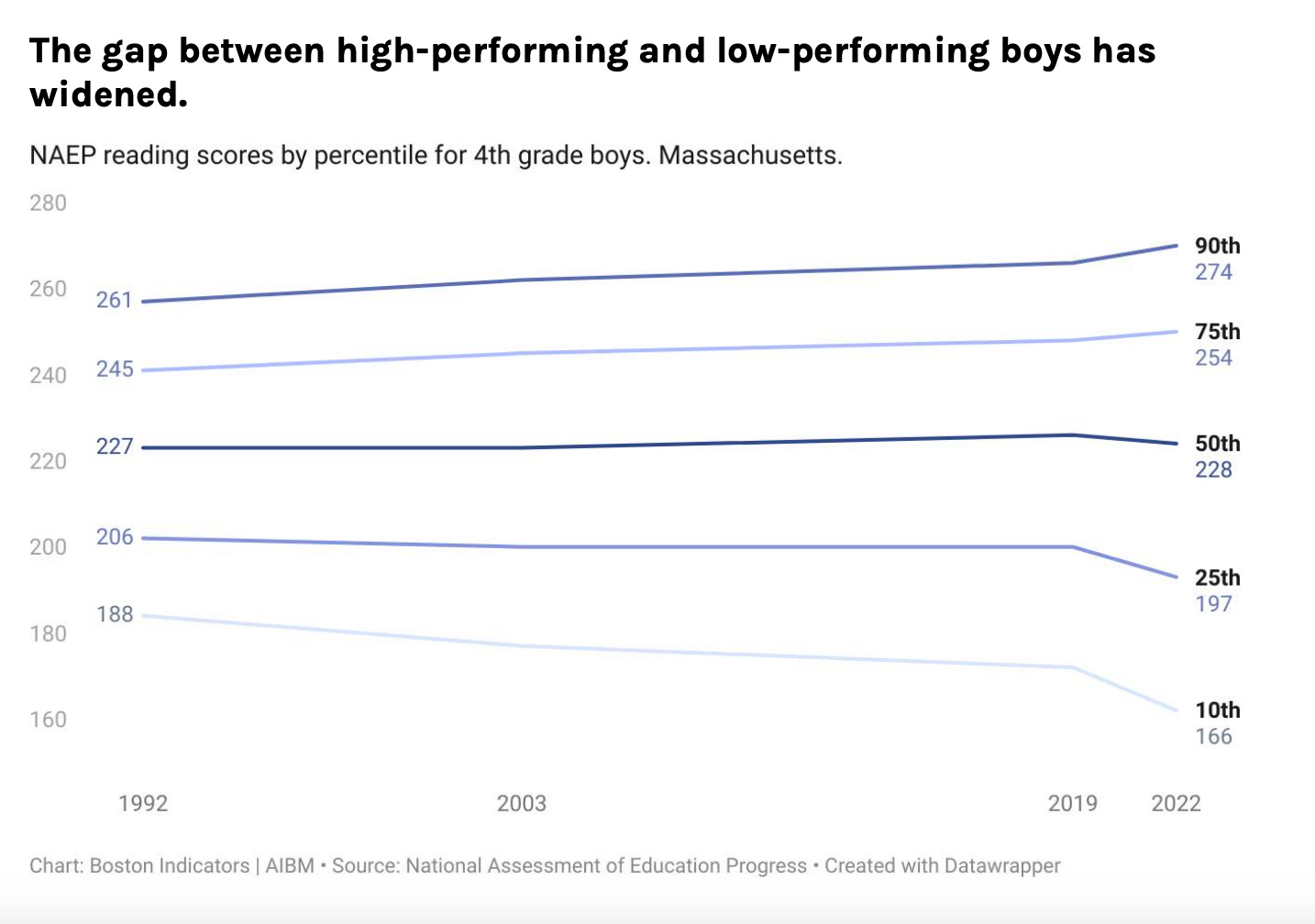
It’s widely known that girls are outpacing boys nationally in educational outcomes. It is also true in Greater Boston and within subgroups, a new Boston Indicators report shows.
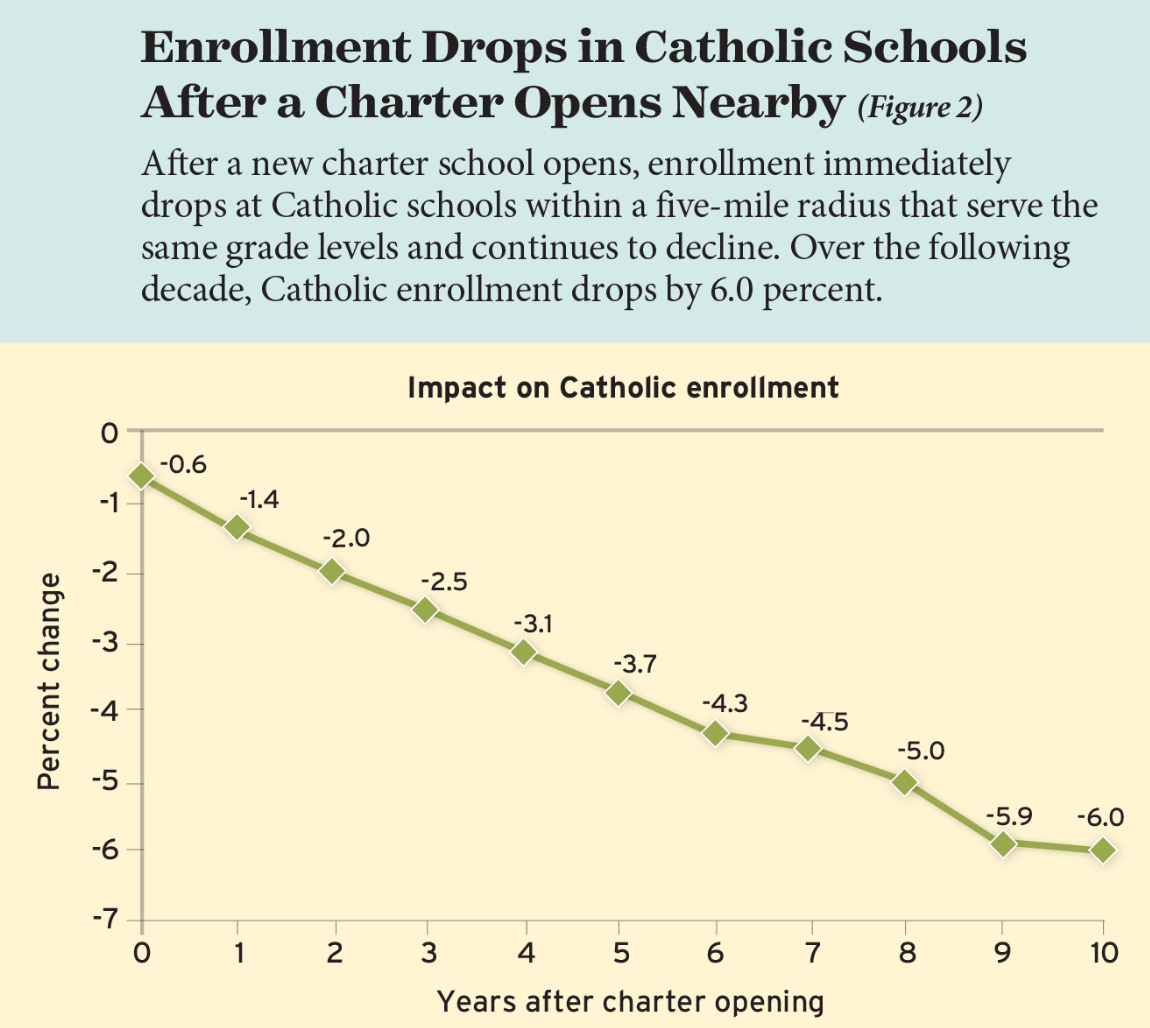
New research supports what many educators sensed over the past two decades: the scaling of charter schools corresponded with the decline of enrollment in nearby Catholic schools.
MA school districts are determining new high school graduation standards without the MCAS requirement.
Remember how this Tuesday was going to be the last day American public schools could have diversity lessons and programs? The final guidance letter reads like a tariff update.
On the other hand, all signs point to follow-through on closing the United States Department of Education. Within moments of being sworn in, Secretary McMahon emailed her new staff about plans to eliminate “bureaucracy” (i.e., them) and there is reporting an executive order was being drafted. The big question remaining is how much of this is reorganization (student loans need to sit somewhere, but really the SBA?) versus actual cuts in federal funding for schools.
Neighborhood Villages has created a helpful newsletter tracking early education news and policy.
Two new reports highlight the positive impact of MA early college programs.
Other Matters
One of the more curious and oft-cited facts is that American health care is a lot more expensive than other countries for worse results.
Massachusetts is not exceptional in this regard. This Commonwealth piece from last week does an outstanding job of explaining why we are paying more to get less for our health care in a state known, well, for its health care.
This is something I thought a lot about while I waited for 42 minutes on Wednesday for a routine, 22-minute physical that was billed out by my provider for $437.