

Boston Focus, 1.30.26
8 MA public high schools you may want to visit in 2026

New SAT data shows little change from what was released last year. Post-pandemic performance across Massachusetts and Boston has been pretty flat.
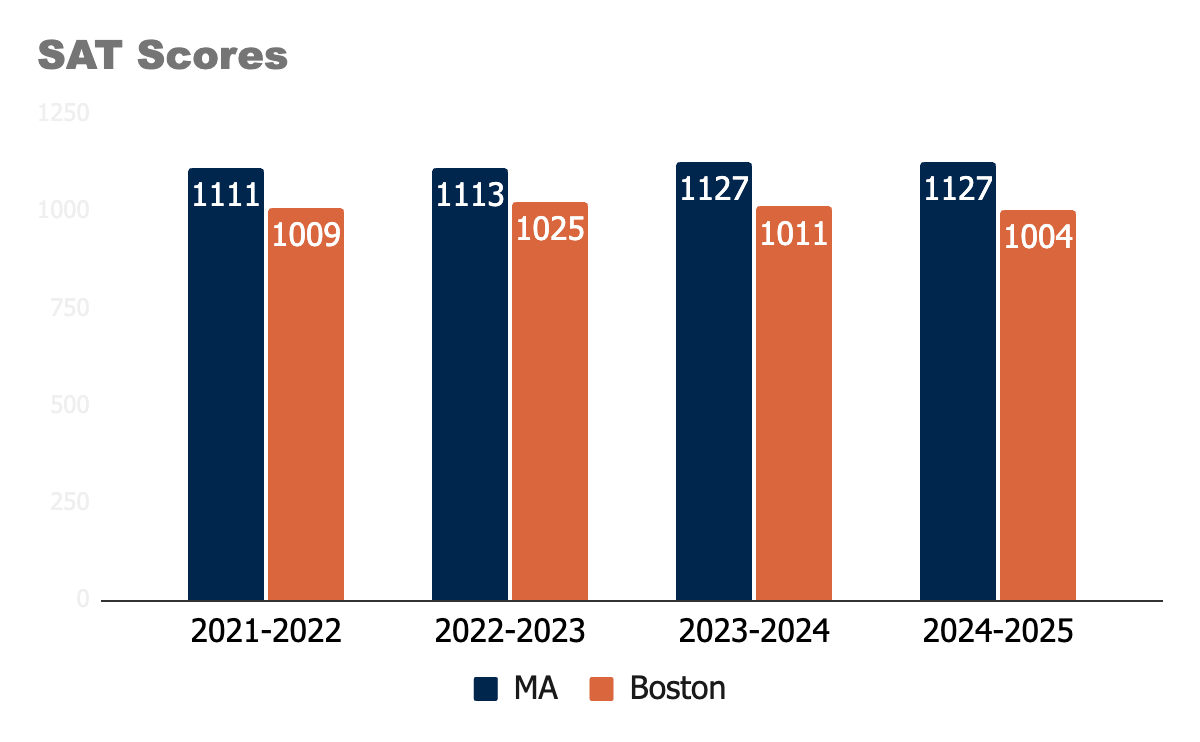
Massachusetts can take some solace in that its students score much higher than the national average of 1024.
The SAT is a pretty limited tool for gauging school quality. Rather than possessing a common standard with the expectation that every student could reach it - like a regular classroom test or even the MCAS - the SAT is designed to assess individuals, with the goal of differentiating them. Plus, not everyone takes it.
The pandemic interruption of the widespread use of the SAT created a bit of a natural experiment to see how important the SAT was in determining a fit for higher education. Recent research indicates it is pretty good, particularly for more competitive colleges. This can be hard to square with the negative public narrative around standardized tests that began in response to No Child Left Behind in 2001, intensified during the “Common Core” fights of the 2010s, and hit a fever pitch in 2020.
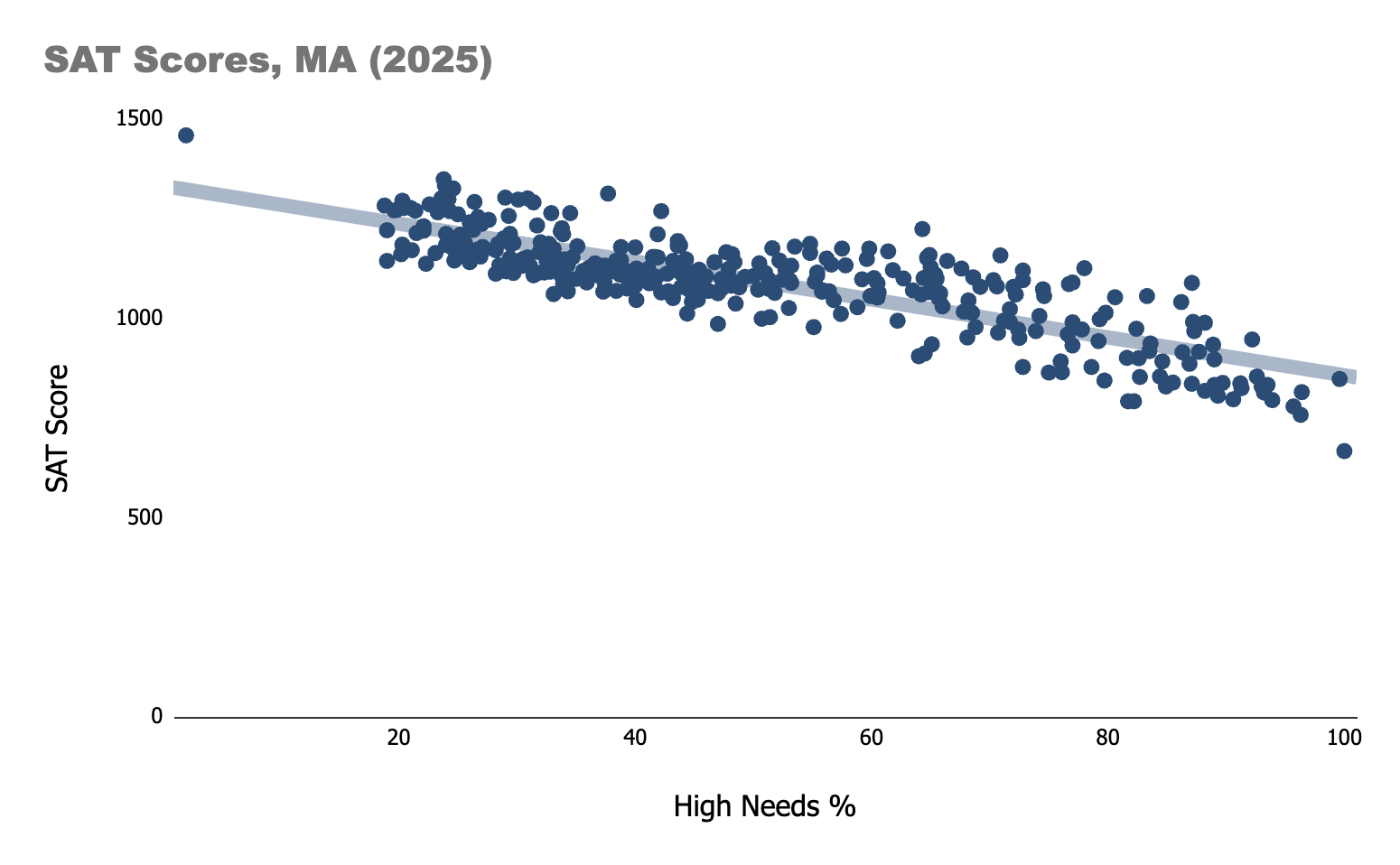
That said, the correlations are hard to ignore. The percentage of high needs students in a Massachusetts school is a strikingly accurate indicator of what the average SAT scores will be (-0.73).
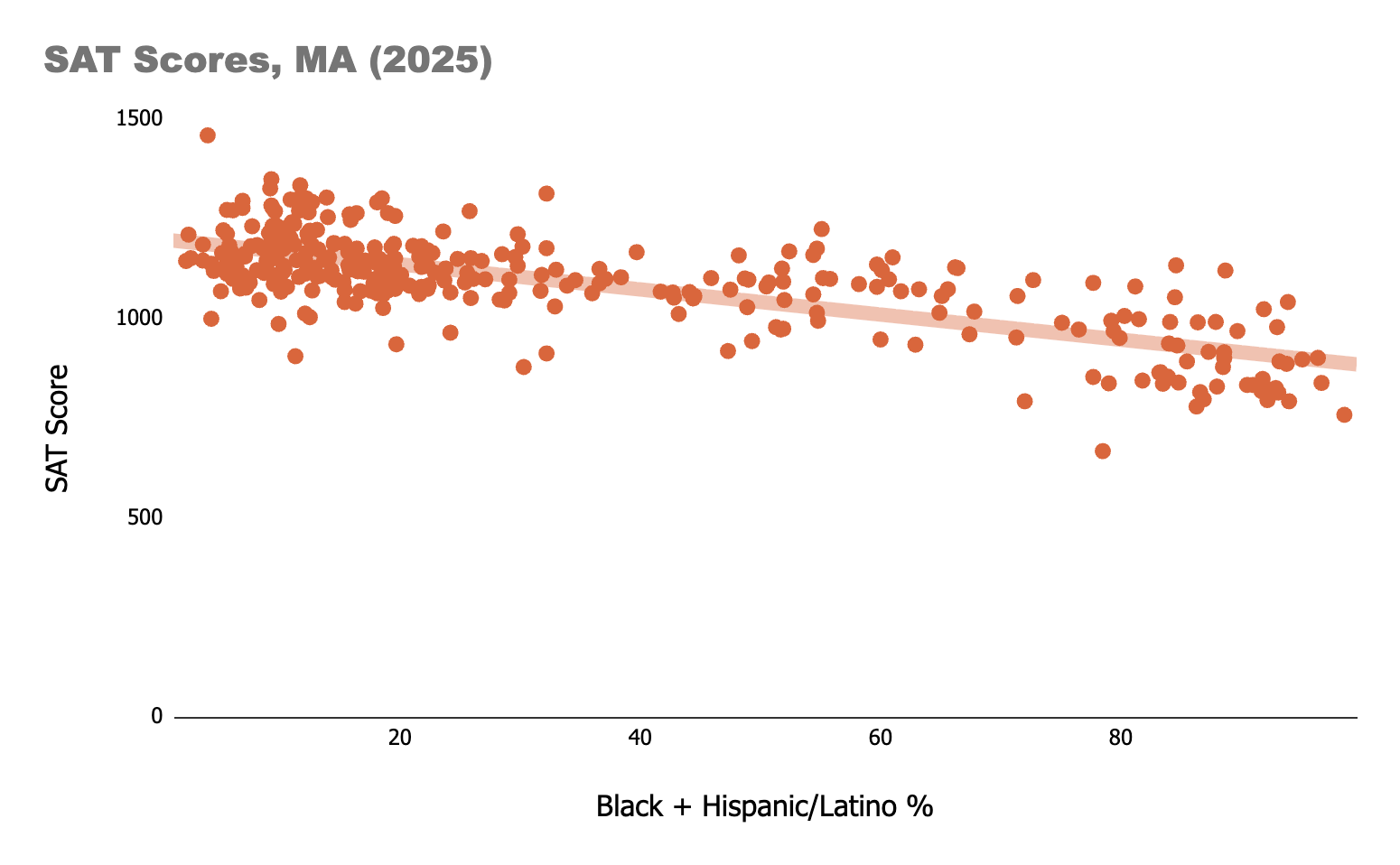
The pattern is nearly identical for race (-0.74).
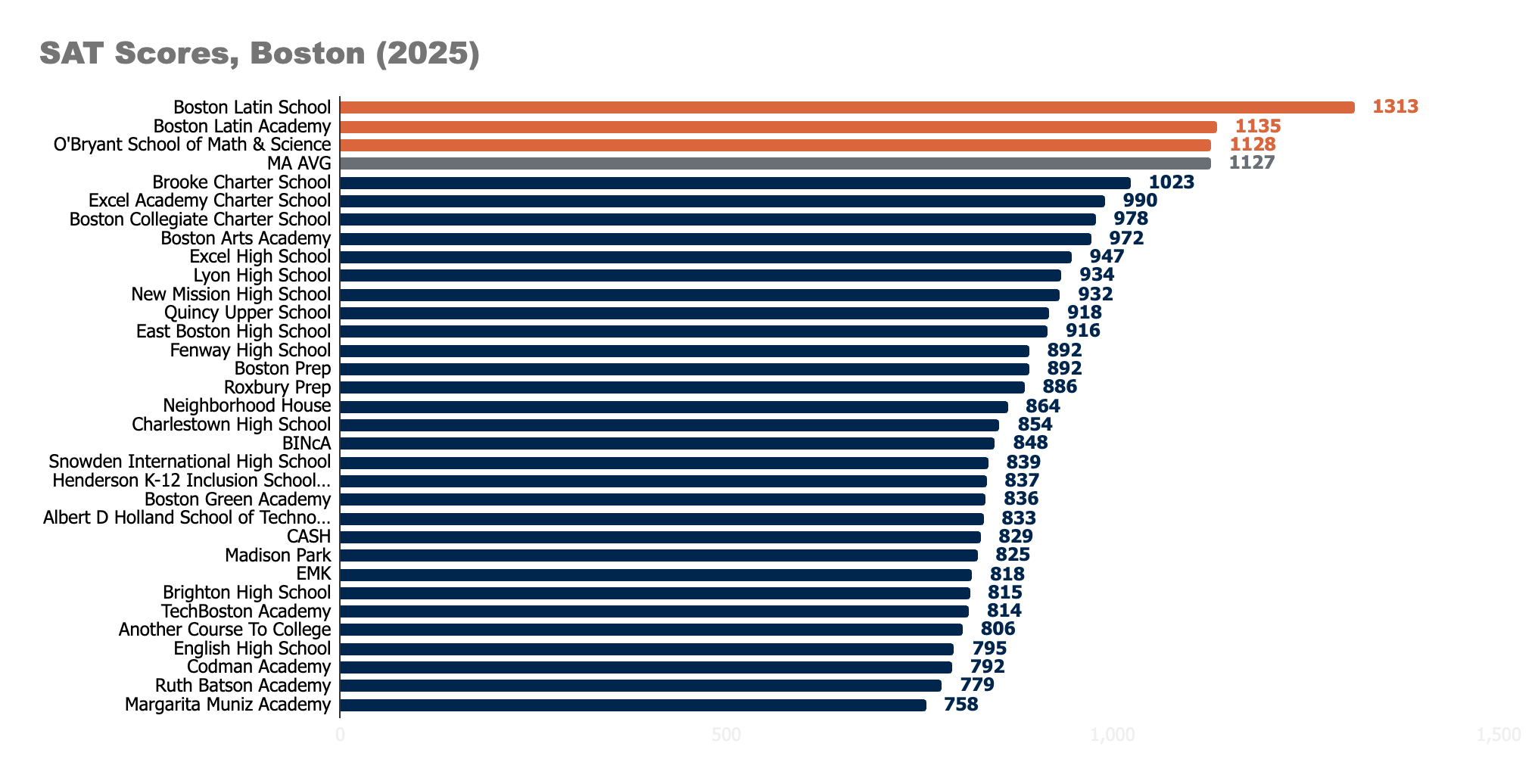
Boston’s pattern is bit more noisy. Yes, the exam schools are the only high schools that beat the state average, but there is a cluster of other high needs schools - including Brooke, Excel, Boston Collegiate, and Boston Arts Academy - that are at or around the national average.
There is an even rarer set of exceptions at the state level. You find them by zooming in on the cluster of dots that are hovering above the line of fit.
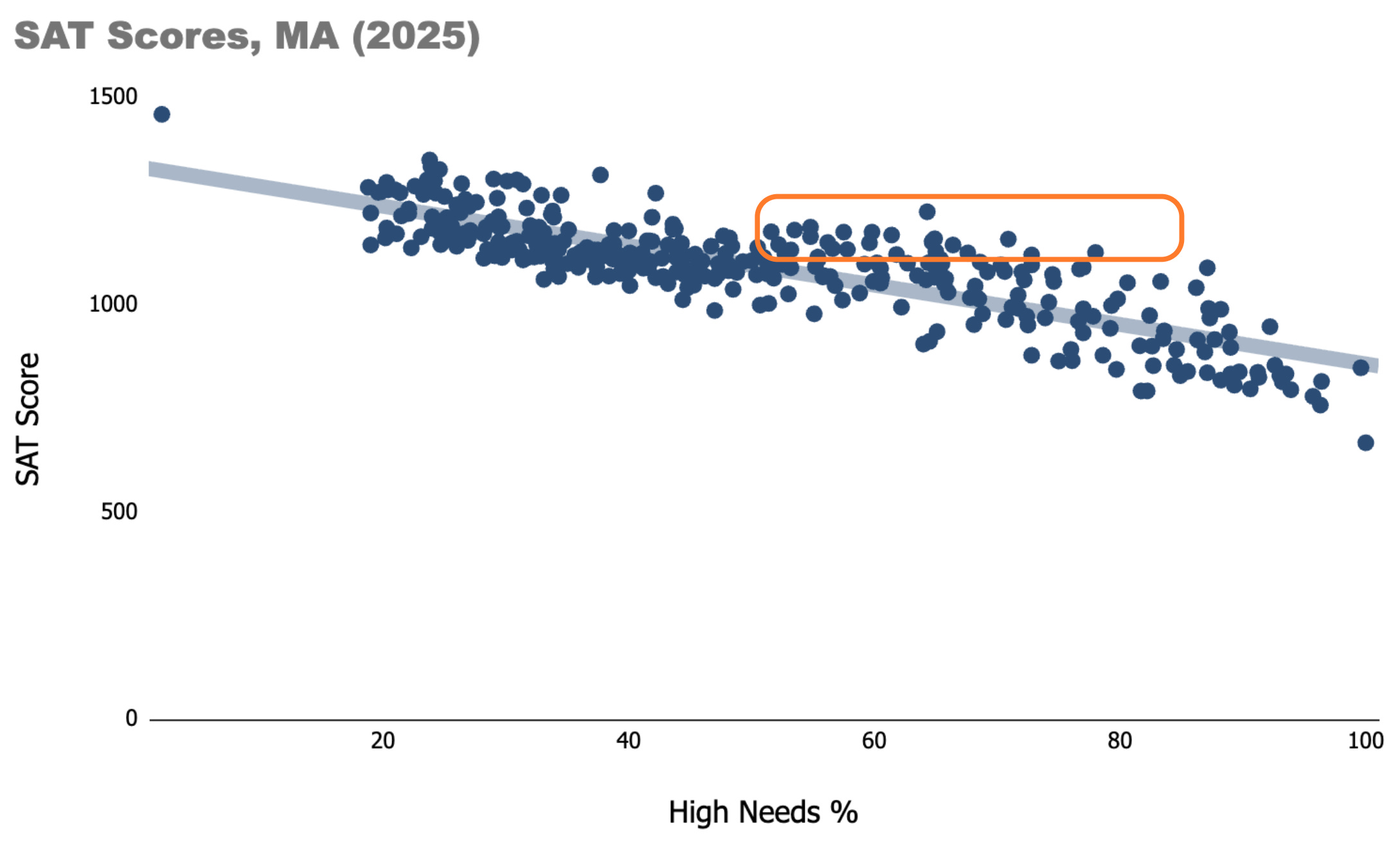
These are the 21 schools that beat Massachusetts SAT average while serving a majority of high needs kids. Eight of those schools also have student bodies that are majority Black and Hispanic/Latino.
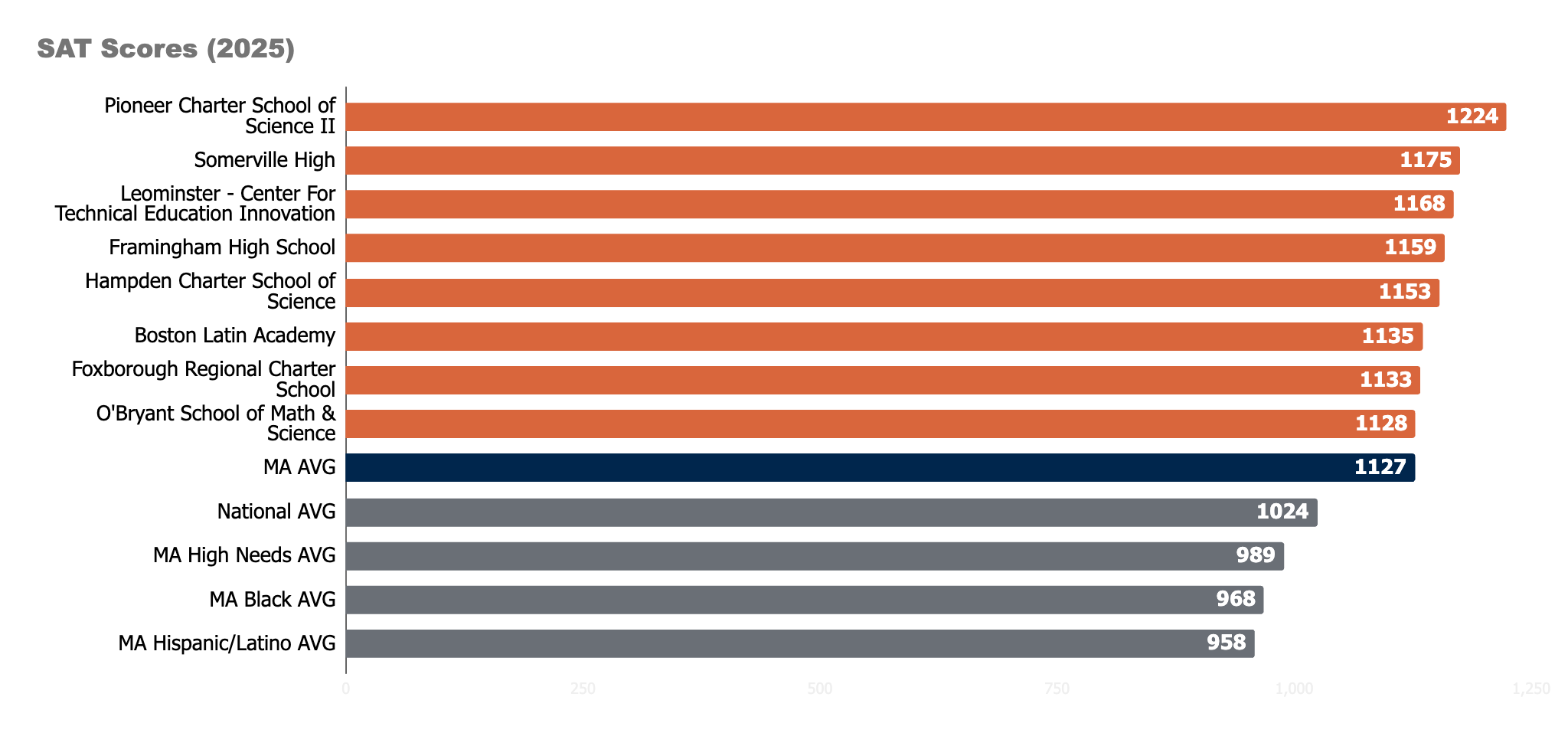
335 Massachusetts public schools reported SAT scores last year.
This small, discernible exception to the rule is both bad and good news. We may not have answers for what to do about the SAT achievement. But at least we have some places educators and policymakers could visit to see how.
Schools
A preview of next week’s BPS budget presentation?
A lively opening Boston City Council meeting waded into several education issues. The potential move of Madison Park to Parcel 3 (and an approved development out) received unanimous consideration. Councilors revived a proposal for a “hybrid” school committee with elected and appointed members and proposed many individual hearing orders, including one on student assignment.
Massachusetts may soon join the ~40 other states enacting laws requiring evidence-based literacy instruction. The Senate unanimously passed its bill last night, leaving a conference with the House and the Governor’s signature as the remaining two steps.
The Board of Elementary and Secondary Education met this week. Materials here. Bigger news preceded the meeting with the announcement that the Lawrence receivership was moving back under direct state control.
Big news also followed with the release of Governor Healey’s $63B+ budget proposal. Good summary here as health care looms large, the state’s largest expense and revenue threat (care of Trump Administration cuts). What does this mean for education? On top of local aid increases, a continuation of Healey Administration priorities and initiatives: universal school meals, free community college, literacy efforts, Student Opportunity Act money, and preK in Gateway cities.
The current state of play for Massachusetts bans on cell phones in schools and limits on social media. Do these bans work? If they reset cultural norms, it may not matter.
All of this technology in schools didn’t come for free. Just as Amazon first used books to acquire data and customers, kids’ Chromebooks were Google’s gateway to its future buyers.
The Rennie Center’s annual release of “Condition of Education in the Commonwealth” yields a new data dashboard.
Questions about days off in Boston and remote school in NYC beg for a research reminder: cancelling school due to inclement weather may be ultimately better for student learning.
If it is new to you, here is a taste of the professionalization of youth sports. I am less hopeful about making things “fairer” amongst elite competitors than I am worried that youth sports participation in general is being hollowed out. Read Tim Daly’s piece.
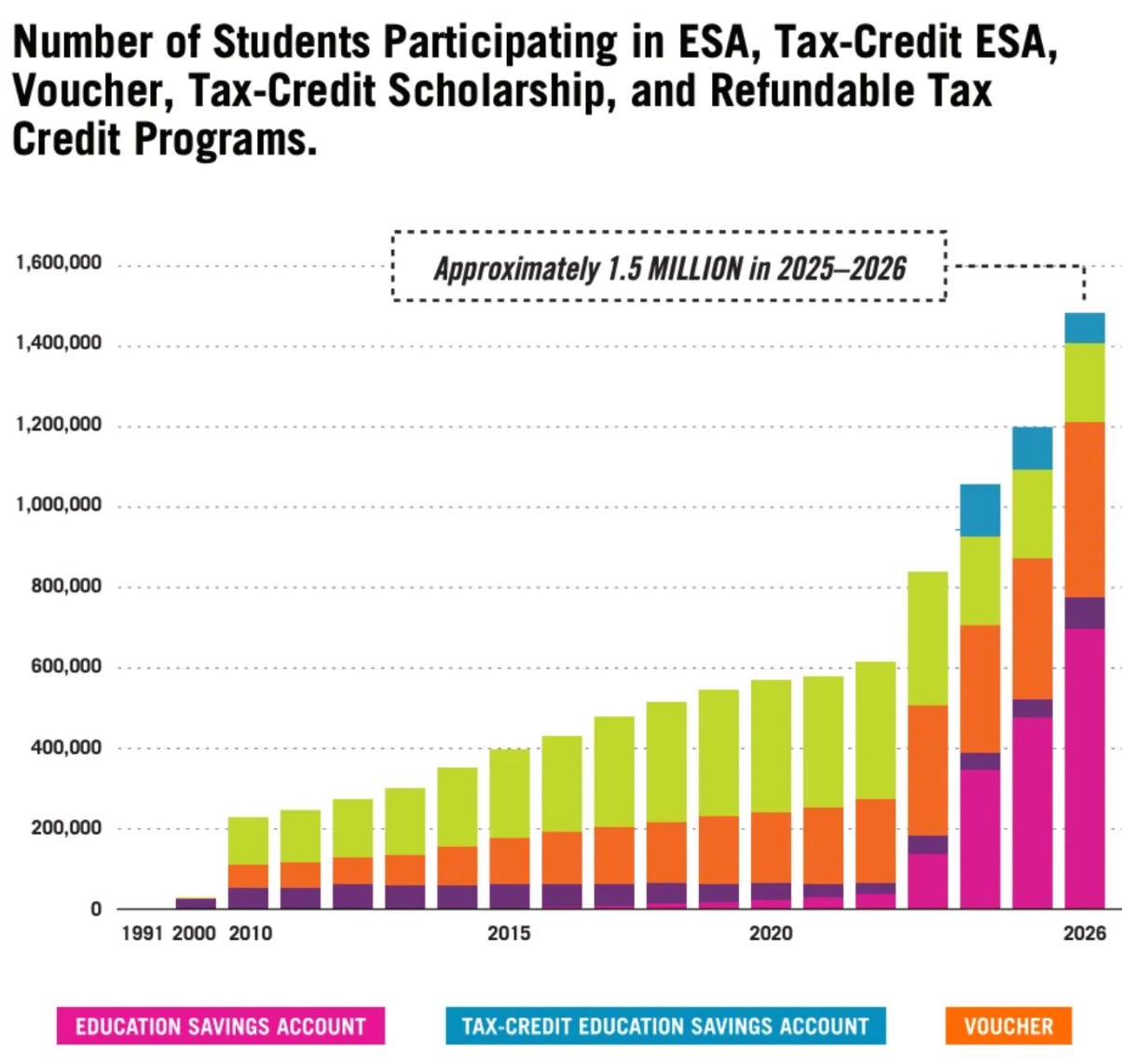
Private school enrollment in America is exploding, fueled by the expansion of Education Savings Accounts (ESAs).
Other Matters
New US Census data is out and population projections are down, driven by a decrease in immigration.
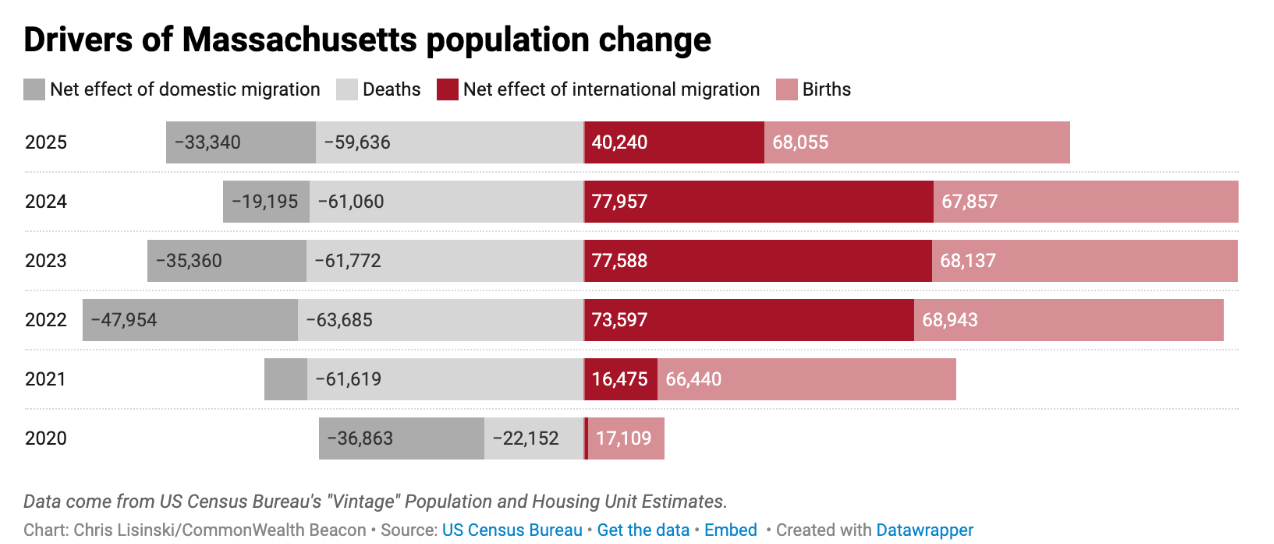
It’s a different story in Massachusetts where immigration accounted for ~83% of Massachusetts’ overall population increase since 2019 (+2.4%). Death and births round out the story. Chris Lisinski from Commonwealth captures it all in one neat graph.
This handy tool from the Boston Globe brings it down to city level. For instance, you can see that since 2019, Boston has lost population, but increased its median income.
There are many factors that contribute to population growth or decline. But it is hard to ignore that, in a state with incredibly expensive housing, more than 180,000 people left Massachusetts while the new MBTA Communities law was only able to produce 7,000 new units of housing.
Being nitpicky but hammering home your underlying point, the MBTA Communities Act has produced a "pipeline" of 7000 new units (in other words, in permitting) which may result in a fraction of that actually being built.