

Boston Focus, 3.20.26
The cost of ratios

Boston Public Schools (BPS) held its final budget hearing on Wednesday (full materials here). At next week’s budget vote, BPS will propose eliminating 292 teaching positions.
As I have written before, changing people or buses is the only way to change the bottomline for BPS. In spite of opposition, BPS has chosen the former, perhaps with good reason. Throughout Massachusetts and in Boston, school staffing is the largest expense and has become more expensive. But not in the way one may think.
The cost increase is not a function of how much teachers are being paid. This has become a bit of a flashpoint in budget debates, like this one in New York City.
Massachusetts just began its annual release of teacher data, which includes salaries. For the first time in two decades, the reported average Massachusetts teacher salary has dropped below per capita income in Massachusetts.
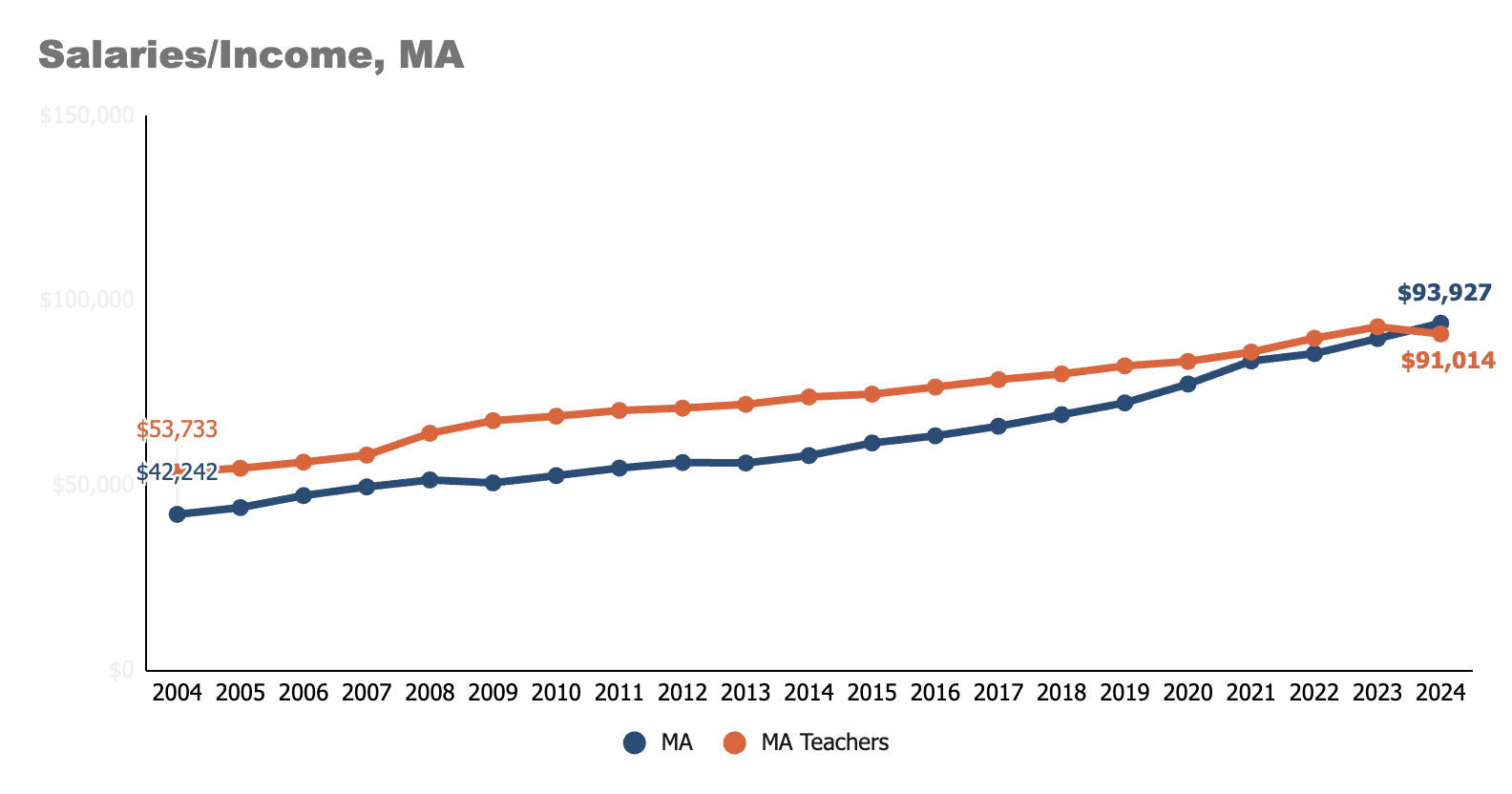
This is a very recent phenomenon. Prior to 2020, Massachusetts teachers averaged a ~19% premium above typical earnings. Since then, each year that premium has declined, bottoming out at 3% below per capita income in 2024.
The picture is more nuanced in Boston. Boston’s teachers have continued to earn more than per capita income in Boston, but on a percentage basis that premium has declined over time.
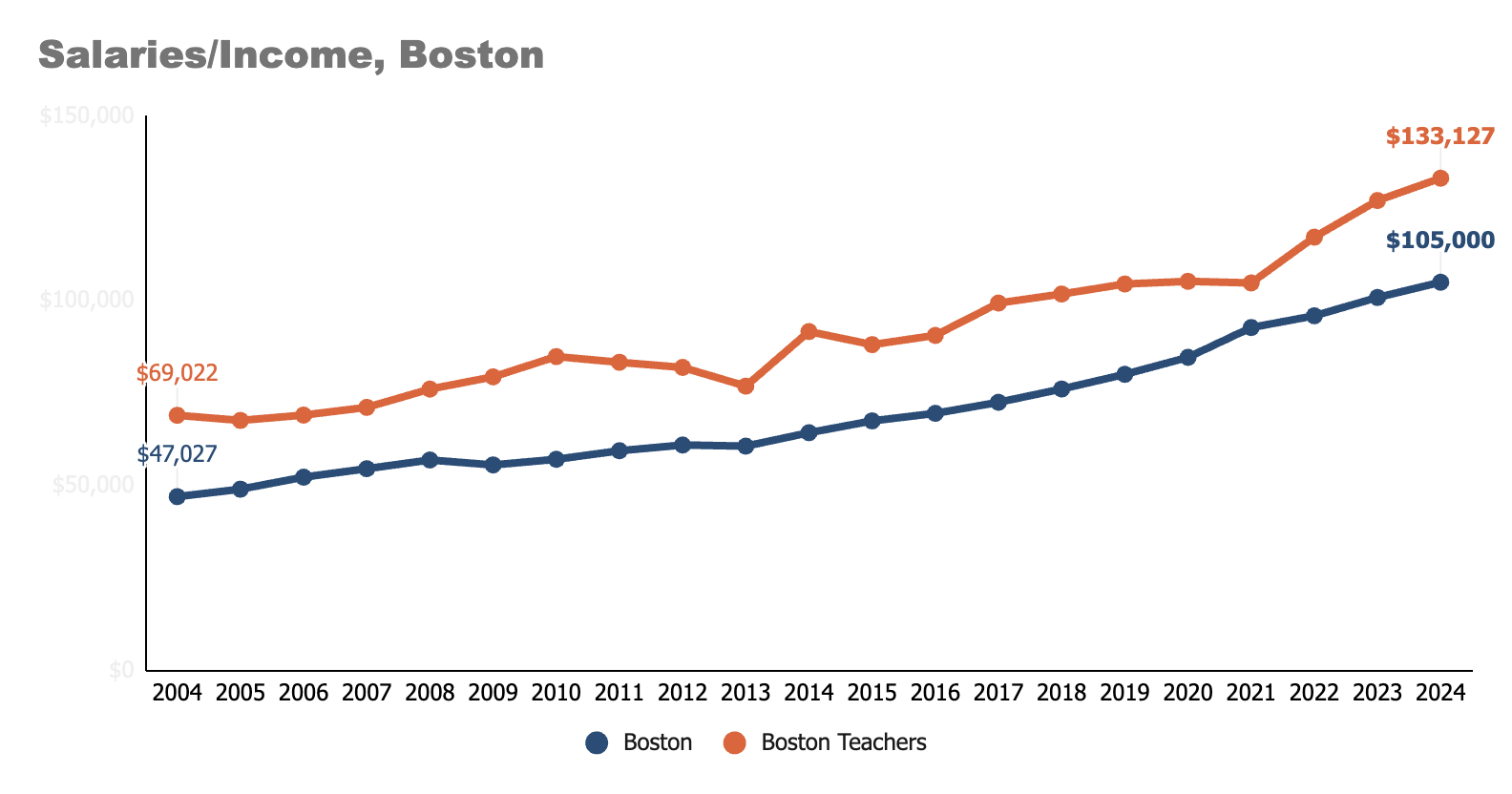
Boston’s per capita income has grown 30% more than teacher salaries during this time period.
So, it is fair to argue that many teachers are paid less than they were 20 years ago.
This is also not likely a consequence of teacher hiring sprees. State and city reporting differ due to how some positions are classified, but if we stick with state data, one sees little change.
Number of Boston teachers reported in 2004: 4,354.
Number of Boston teachers reported in 2024: 4,385.
Only a 0.7% increase. The budget squeeze in Boston does not come from what the city pays teachers or even how many teachers there are.
The budget squeeze in Boston comes from what the city pays teachers and how many teachers there are relative to the number of students.
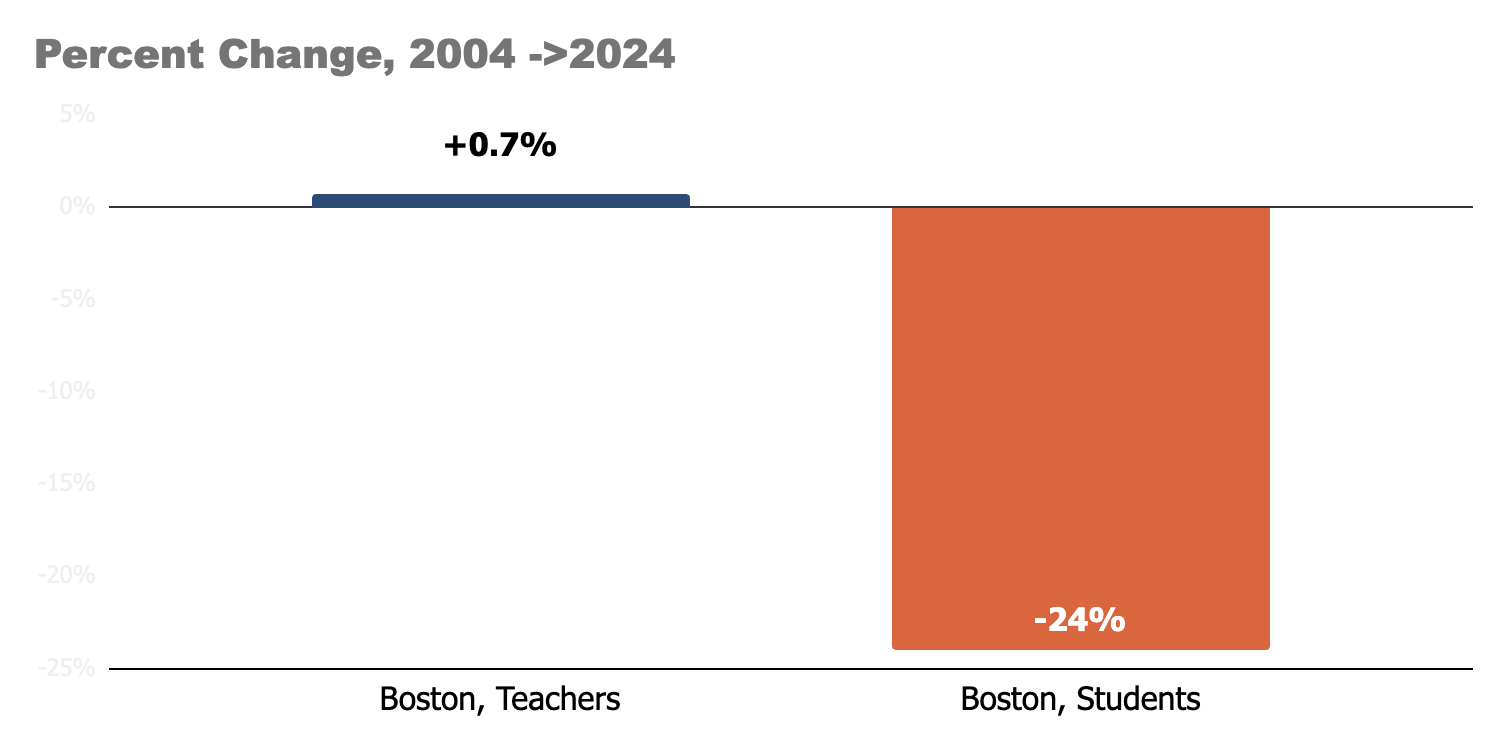
The loss of students both reduces revenue and increases inefficiency. For the former, state and federal aid - which is tied to the number of students and their demography - declines; for the latter, schools and schedules carry more classrooms (and teachers) that they actually need.
But aren’t smaller classes good? Reduced staffing ratios - some which were needed for accommodations for students with special needs and multilingual leaders - comes with a heavy price without a very strong research basis to support it.
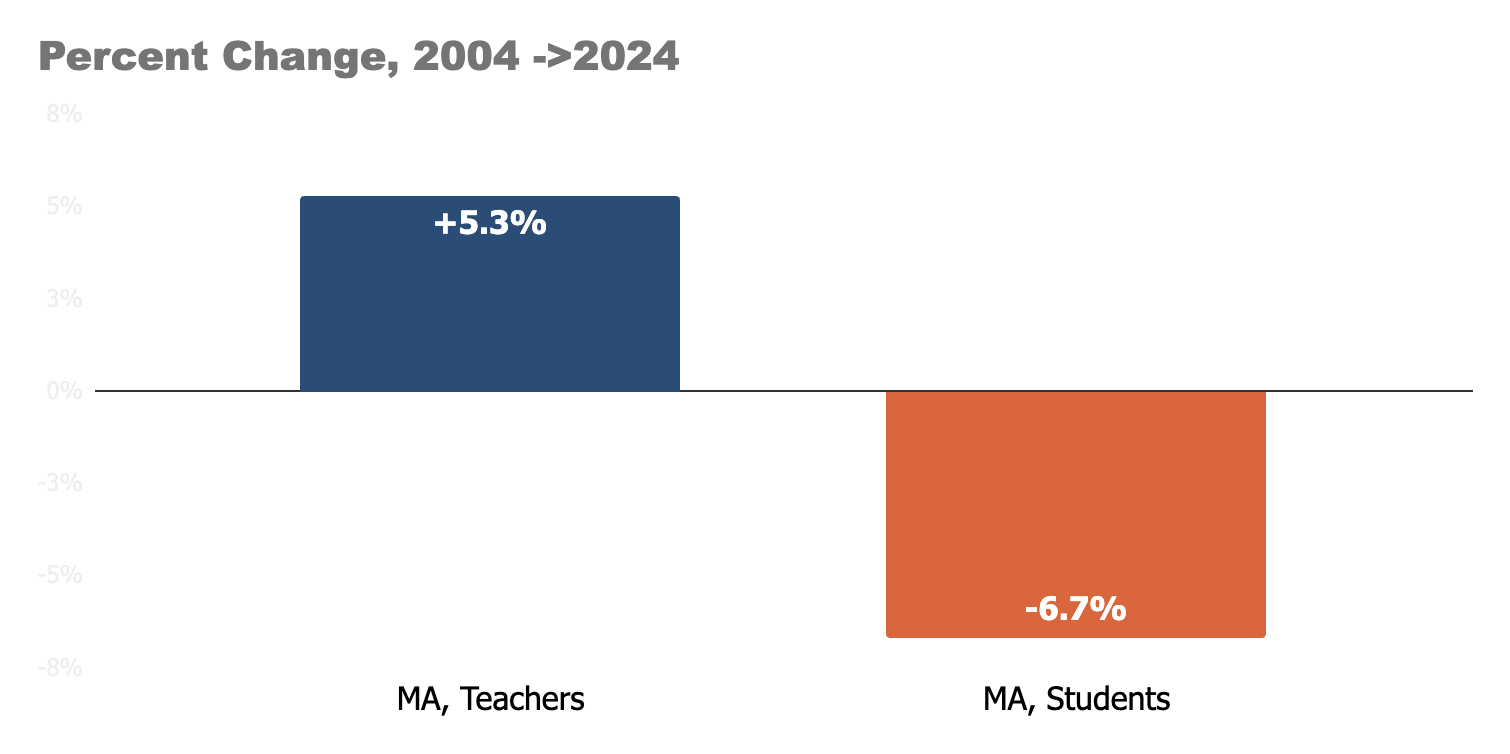
A similar gap formed across all Massachusetts public schools at the same time, also creating lower staffing ratios that districts are struggling now to maintain.
Many school districts have responded by closing schools.
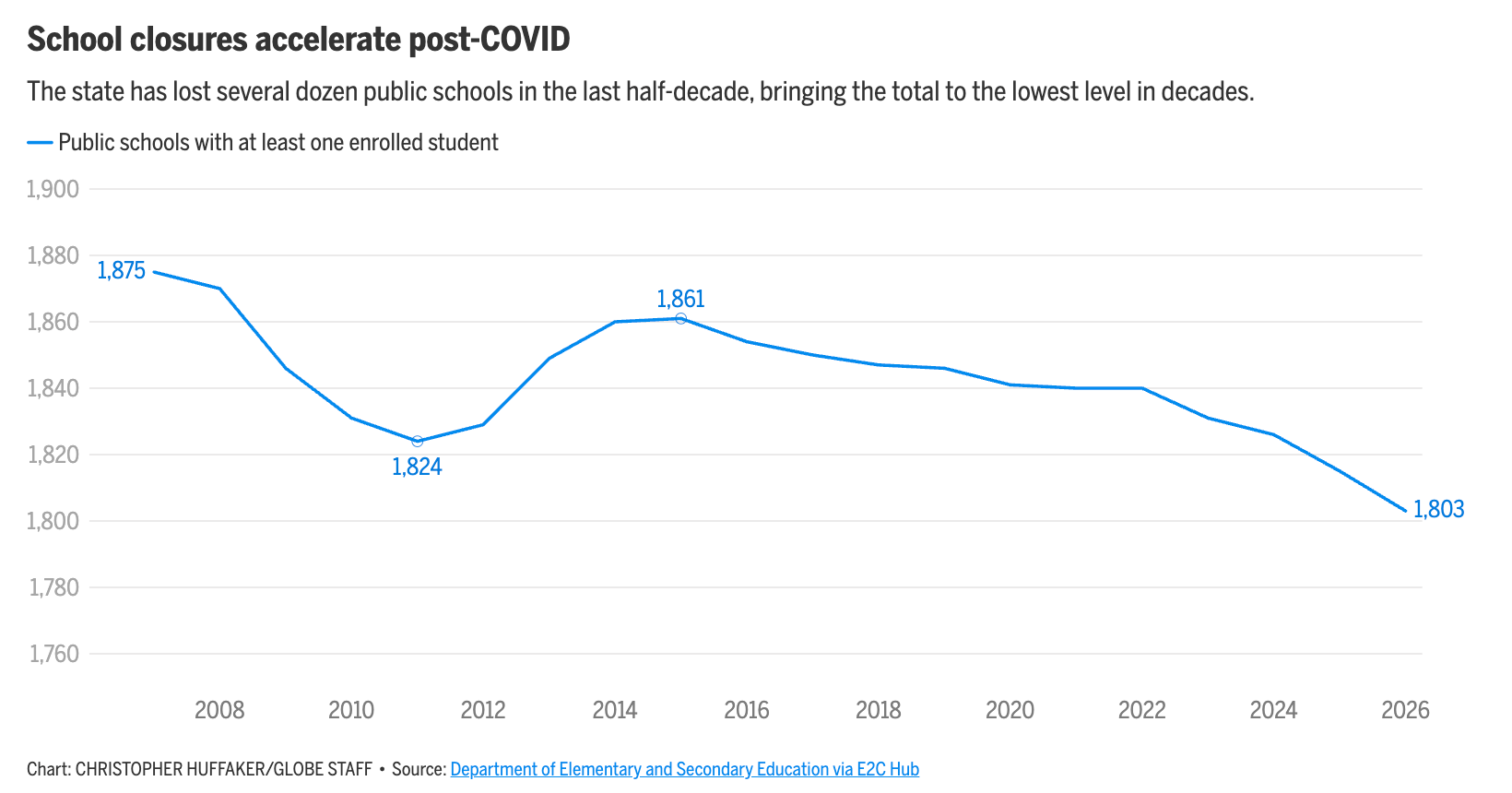
This is likely not the full answer. As a practical matter, Massachusetts school closures (-3%) have not kept pace with student population decline (-6.7%) since 2004.
More fundamentally, closing a school building does not address the actual cost driver for each school building: its staff. Without cause or layoffs, tenured teachers from those buildings are guaranteed another job under state law. Boston has endured many closures and consolidations over the past 20 years, but this is the first budget in recent record that eliminates a significant number of teacher positions.
Still, districts will struggle to catch up to the math. If Massachusetts school districts intended to return to previous staffing ratios, nearly 9,000 teaching positions would need to be eliminated. Boston alone would have to drop its teaching workforce by a least 1,000.
Districts would have been hard-pressed to contemplate these sort scenarios a few years back. With stronger fiscal health, Boston and other school districts could just pay to maintain or even increase staffing levels. Smaller staffing ratios was a choice that could be afforded, even cast as an investment.
Was that the right choice? Unfortunately, that is going to be tested in the coming years.
Schools
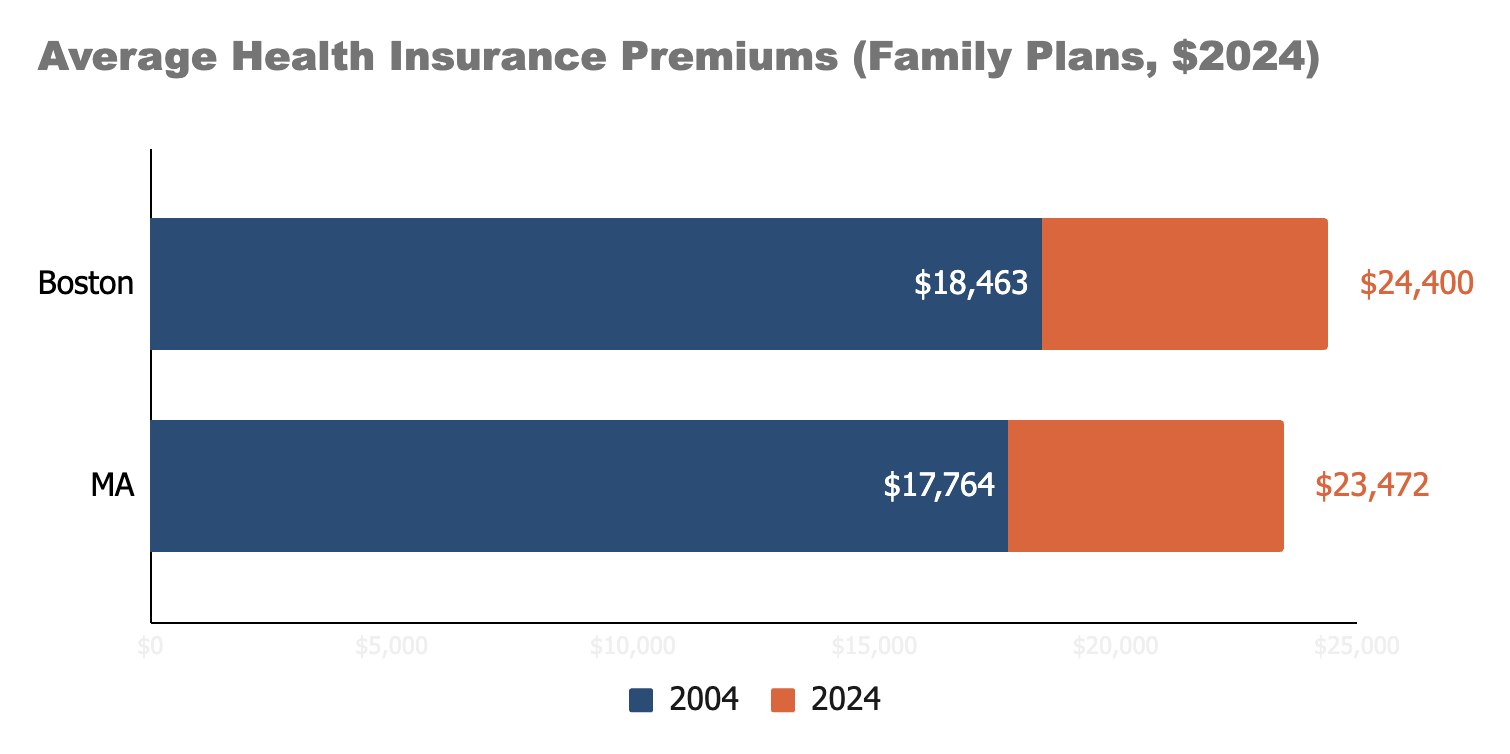
What do weight-loss drugs have to do with BPS budget cuts? Benefit costs are the largest budget line increase in the BPS budget this year (+$40M) and in manyother school districts.
Any school closure is bad, but the potential one now facing the Croft School (campuses in Jamaica Plain and the South End) is uniquely bad.
Another informative Codcast that digs into how immigration policies are affecting school enrollment in Massachusetts.
Two op-eds call for higher standards for high school graduation in Massachusetts, specifically end-of-course exams.
A new NBER paper is a warning to not rely on grades alone.
Does the backlash against edtech in the classroom have merit?
Pittsburgh Public Schools is moving its schools to remote instruction because the city is hosting the NFL Draft (the Eagles’ fans jokes write themselves).
At least we aren’t alone. The country is also feeling a school enrollment crunch and considering a literacy bill.
Other Matters
I joined legislators, officials, and advocates at the State House yesterday to recognize March as Problem Gambling Awareness Month. It was encouraging to hear support for greater regulation, while also sobering to review data from the Department of Public Health and the Massachusetts Gaming Commission’s outstanding bank of research.
There was something to celebrate. A proposed iGaming bill - which would have allowed FanDuel to create online slot machines during halftimes - was sent to study. It will likely be refiled next year.
Thanks to Colin Hogan of the New Bedford Light, I found an error in the AP analysis from two weeks ago. There is a big gap in AP performance, just not as big as a flawed Excel formula yielded. Updated post here.